Orwell's World by Stephen Zelnick
“Orwellian” means hiding murderous state actions with euphemisms. “Liberating” means enslaving; “pacifying” killing everyone; “collateral damage” wiping out civilians; and recently a “Board of Peace”. Orwell imagined a “Ministry of Love” and we get the joke. However, 1984 goes much further, with systems controlling past and future, employing daily surveillance, and inventing narratives that overwhelm us.
These days we are aswarm in narratives concerning institutions, our empire, the fate of nations, laws and limits, and wars in Ukraine, Iran, Gaza, and Venezuela. Facebook friends tread carefully by my posts; my computer keystrokes may be being recorded. Born in the USA, I now carry my birth certificate and keep a copy in my files.
Data centers now under construction soon will archive every fact and feature. As I type, a co-pilot alerts me to non-standard usage and when a metaphor pushes boundaries.
Sometime soon, these “errors” will be scored, and my grandchildren may find themselves unemployable. Nothing can be exaggerated.
Retired, I live on previous income. My Social Security payments could be stopped, bank accounts and credit cards shut down, and travel restricted, as happened recently to punish a respected Swiss citizen for his writings and associations. Highly integrated information systems, far beyond Orwell’s imagining, can erase us at a whim of power and without review.
I encounter few people with heads, even among the well-credentialed, not filled with carefully textured stories, stock phrases and disinformation. I guard my comments on Israeli assaults, protests in Iran, and much more, to avoid being thought—not a Communist, but a lunatic. For my neighbors, War is Peace; Freedom is Slavery; and Ignorance is Strength. Orwell saw this coming.
In the neo-liberal West, power is real and truth a phantom. In the US, the Powell Memorandum of 1971 set plans to bend a liberal society to the needs of property. Law and traditional values, we have learned, collapse when pitted against corporate power and the managed marketplace. Lewis Powell advised corporate control of universities, science, and media. He’s had his way.
William Casey, appointed CIA director in 1981, boasted: “We’ll know our disinformation program is complete when everything the US public believes is false.” Hyperbolic? … not in a world with multiple realities—where, as Kellyanne Conway put it, there are “real and alternative facts”—Lewis Powell and Lewis Carroll are one.
Republican advisor Karl Rove went further. Rove told his interviewer, “We’re an empire now, and when we act, we create our own reality. And while you’re studying that reality—judiciously, as you will—we’ll act again, creating other new realities, which you can study too, and that’s how things will sort out. We’re history’s actors … and you will be left to just study what we do.” It’s what O’Brien tells Winston Smith.
In 1984 (1948) Orwell mapped the future, but we now know what happens from 1948 to now. No nuclear war in the 1950s, London will not become Airstrip One, and our future will not be rats and rusty razor blades. But otherwise, Orwell got it right. Perpetual war has become an economic necessity and a means of social control; language has been impoverished; someone or thing watches us and takes notes.
Julia’s question is ours—how deep can state power invade our minds and hearts: “‘They can’t do that,’ she said finally. ‘It’s the one thing they can’t do. They can make you say anything—anything—but they can’t make you believe it. They can’t get inside you …’” The horror of 1984 is that the walls of consciousness are shattered, and we submit gratefully.
Winston observes: “They could not alter your feelings; for that matter you could not alter them yourself, even if you wanted to. They could lay bare in the utmost detail everything that you had done or said or thought; but the inner heart, whose workings were mysterious even to yourself, remained impregnable.” This turns out to be romantic nonsense. Orwell warned us, and we do well to take him seriously.
II
Orwell was a democratic socialist but also an anarchist, as an artist should be. Capitalism, serving profits alone, could not decide in 1939 whether to produce tanks or toiletries.
Orwell expected that Britain’s conversion to a state-controlled, wartime economy would be permanent, and that England would emerge democratic-socialist.
Orwell was an odd revolutionary. He opposed any socialism that offended English decency. While socialism would require reorganizing production and social relations, Orwell was dead set against Communist dictatorship, either by the proletariat or in its name. His Spanish Civil War experience convinced him that Communism placed draconian order above human rights and respect for individuals.
His dystopia is more insidious than others. Arthur Koestler’s Darkness at Noon (1940) dramatizes terror within the party; Orwell portrays an entire world set rigidly into its own imprisonment. Oceania sets every facet of existence in compliance and demands enthusiastic submission.
As a police officer in Burma with baton in hand, Orwell had participated in physical domination. “Orwellian” points, however, to the power of narratives to enlist consent. Orwell was hardly alone in seeing this force at work. Edward Bernays’ Propaganda (1928) suggested marketing goods by shaping desires. In 1929, Bernays advised the tobacco industry to refer to cigarettes as “torches of freedom” to recruit women smokers; in 1955, he advised United Fruit in Guatemala to sell regime change as democracy. We live in Bernays’ world.
Bernays, Sigmund Freud’s nephew, advised that sales can be cultivated by artists of the imagination, but also that engineers of consciousness could command political power. Bernays says it aloud: “The conscious and intelligent manipulation of the organized habits and opinions of the masses is an important element in democratic society. Those who manipulate this unseen mechanism of society constitute an invisible government which is the true ruling power of our country.”
Bernays cites WWI propaganda: “the manipulators of patriotic opinion made use of the mental clichés and the emotional habits of the public to produce mass reactions against the alleged atrocities, the terror and the tyranny of the enemy. It was only natural, after the war ended, that intelligent persons should ask themselves whether it was not possible to apply a similar technique to the problems of peace.”
III
His voice, made metallic by the amplifiers, boomed forth an endless catalogue of atrocities, massacres, deportations, lootings, rapings, torture of prisoners, bombing of civilians, lying propaganda, unjust aggressions, broken treaties. It was almost impossible to listen to him without being first convinced and then maddened. At every few moments the fury of the crowd boiled over and the voice of the speaker was drowned by a wild beastlike roaring that rose uncontrollably from thousands of throats.”
Unlike Bernays, Goebbels rates the wish for happiness far below the “thrill of horror”, but then he wasn’t selling summer frocks. Goebbels mocked appealing to intellect: “intellectuals would never be converted [to Nazism] and would anyway always yield to the stronger, and this will always be ‘the man in the street.’ Arguments must be crude, clear and forcible, and appeal to emotions and instincts.”
Goebbels instructs Orwell’s novel. Towards the end of Winston Smith’s “cure”, he is induced to recognize 2+2=5. This is the penultimate test of his salvation from being a mere speck in a vast universe, to merging himself with the power of history. Goebbels puts it: “It would not be impossible to prove with sufficient repetition and a psychological understanding of the people concerned that a square is in fact a circle. They are mere words, and words can be molded until they clothe ideas and disguise their meaning.”
Put another way, “To be a [national] socialist means to let the ego serve the neighbor, to sacrifice the self for the whole. In its deepest sense socialism equals service. The individual refrains and the commonwealth commands.” The ultimate measure, however, is not to admire Hitler’s ideas or his success but to love him, as Smith comes to do Big Brother. Like O’Brien, Goebbels explains: “Do not seek Adolf Hitler with your mind. You will find him through the strength of your hearts.”
IV
James Burnham’s The Managerial Revolution (1940) also informs Orwell. For Burnham, society will always be organized into (1) a leadership group; (2) a group of craftsmen (of things and ideas); and (3) the great many.
Names change but these three groups persist at all times and places. Age-old dreams of equality are nonsense. In 1984 the Inner Party (O’Brien) commands; the Outer Party (to which Winston Smith belongs) facilitates; and Proles simply exist.
Lewis F. Powell, Jr., a corporate lawyer and later a Supreme Court justice, was the sort of activist Burnham had in mind. Powell shaped the conservative rebellion against FDR’s New Deal. Powell’s famous 1971 Memorandum taught conservatism how to fight back with think tanks, organized politics, control of the judiciary, and invasion of the universities and public media to promote the “free enterprise” fable.
Powell spent his career helping convince the public and the courts that cigarettes posed no health risks. He railed against Ralph Nader, author of Unsafe at Any Speed (1965), who exposed the rising incidence of death and serious injury resulting from faulty automobile design. For Powell, exposing the dangers of smoking or promoting auto safety violated the sacred rights of free trade.
But the essential impact of the Memorandum was to limit the force and role of unions. Limit pay and benefits, workplace health and safety, and hiring and job security, and the great many could be brought to heel by the owners of property and their political and judicial machinery. Corporate owners needed to push back against worker gains and the emerging middle class, who needed to be taught the American way and who rules in a capitalist system. These changes were accomplished with the help of devilish clever narrative control.
Powell’s memorandum proposes how to bring this about. Open class war had been haphazard. It required understanding how to promote corporate power by marshalling capitalist force in education, intellectual production and distribution, the arts—TV, films, literature, politics—state legislatures, Congress, the judiciary, and think tanks, and installing a notion of balance to ensure owners and their interests a “fair hearing”. In most cases a panel of scientists and academics was no match for a talented pitchman well-schooled in messaging and media, and certainly no match for Ronald Reagan or Margaret Thatcher. In education, Powell proposed a thorough program—controlling the hiring and promotion in universities to favor conservatives, control textbook selection, strengthen business schools, manage boards of trustees; and so on. In policy and politics, he recommended taking control of state legislatures (ALEC); the appointment of judges (Federalist Society);and networking to provide substantial funding (Heritage Foundation) to promote corporate policy … and all of this from behind the curtain.
Powell emphasized limiting worker access to security. An expanding economy required instead a high degree of fear to make workers obey and respect corporate power, disguised as public order and “the American Way”. A worker who couldn’t rest easy would do as he was told and settle for a smaller portion of the profits, in fear of losing his job and compromising his family’s welfare.
V
Orwell had studied working-class life in Down and Out in Paris and London (1933), The Road to Wigan Pier (1937), and, in Spain, Homage to Catalonia (1938). His hopes for democracy and an end to mass misery required a revolution driven by working-class resentment. However, his hopefulness declined as war approached and victory placed power into the hands of Burnham’s managerial elite.
In 1984, the prospects for revolution collapse. The Proles don’t manufacture anything, work the fields, or fight wars. They aren’t mass consumers. If anyone approaches political consciousness, he is “vanished”. There are no general strikes or Paris Communes. In Orwell’s novel, Proles mill about bewildered, squabbling over tin pans.
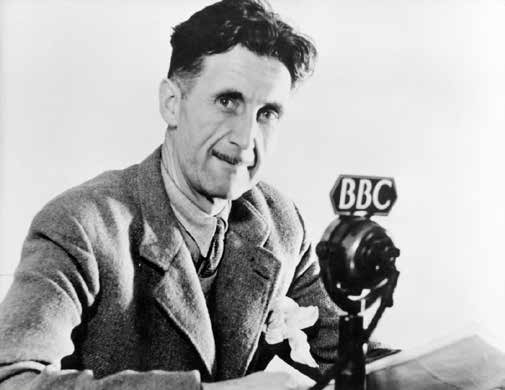
Winston Smith hopes the Proles will rebel, but O’Brien assures him this could never happen, and that his hopes are fanciful. Smith knows the masses are led by fictions; indeed, he writes them. Early in the war, when England’s fate hung in the balance, Orwell himself dished out propaganda at the BBC, assuring listeners things were going well when he knew they weren’t.
In his essay “Looking Back at the Spanish War” (1942) Orwell recalled: “In Spain … I saw great battles reported where there had been no fighting, and complete silence where hundreds of men had been killed. I saw troops who had fought bravely denounced as cowards and traitors, and others who had never seen a shot fired hailed as the heroes of imaginary victories; and I saw newspapers in London retailing these lies and eager intellectuals building emotional superstructures over events that had never happened.”
Much of Orwell’s excellence comes from giving events, places, and people a hard look to understand them. In The Road to Wigan Pier, Orwell looks beyond sentiment to see the slovenly mess of daily life in Northern coal districts. Party socialists entertain imaginary rebellion, but Orwell records only grim endurance.
Orwell’s commitment to hard facts made him wild with despair at the illusions that rule men’s minds. As “Politics and the English Language” (1946) demonstrates, every word and phrase is a battleground where illusions creep in. Although he justified his service to BBC’s propaganda, he quit when war prospects improved. Orwell most of all hated lies.
Orwell’s dark prophecy in 1984 gets to the deep derangement that rules our day. It isn’t that sales techniques and patriotism fool us, or that force rules, but that the “us” vanishes. Remove the structuring frames and “doublethink”—removing the awareness of knowing how we know what we know—prevails, and we disappear.
It seems unlikely Orwell knew, but beginning in the early 1940s Nazi scientists experimented on concentration camp prisoners in mind control. These included mind-altering drugs but also physical torture. In Operation MKUltra (1953–1973), the CIA took up these experiments to erase the will of its subjects. The story is dramatized in the novel The Manchurian Candidate (1959) and film (1962). Governments have since found softer ways of altering minds.
VI
In Oceania, the Party shapes thoughts by limiting language. The masters of reality control their subjects’ understanding from the deepest recesses of their minds. 1984 dismantles Julia’s confidence about the limits of mind control. Late in his reprogramming, Winston Smith not only sees four fingers as five but is relieved that he can.
As O’Brien explains, the Party requires not submission but cooperation as the subject is absorbed into a new reality. Orwell anticipates Invasion of the Body Snatchers (1956), The Manchurian Candidate (1962), A Clockwork Orange (1971) and The Stepford Wives (1975). In The Matrix (1999) and Inception (2010) walls of consciousness are so shattered we walk around in one another’s dreams.
It isn’t only that phrases are crammed into people for mechanical recitation but that those formulations make sense. The clearest instance is that of the three slogans inscribed everywhere in Oceania. Orwell mounts a debate in his novel between the rebellious teachings of Goldstein’s “The Book” and O’Brien’s forceful lectures aimed at Winston Smith and at the reader.
War is Peace—Freedom is Slavery—Ignorance is Strength
Is this the Laputa lunacy of Swift’s Gulliver’s Travels (1726), or the way things are?
VII
In the United States, “War is Peace”. Enemies at the gates terrorize Oceania, with reports of deadly battles and narrow escapes. Our own “Inner Party” thrives on images of threats to “the homeland” and the weapons to keep us safe. Our perpetual anxiety-release cycle supports sanity.
In Oceania, “Screamers” take a modest toll, and casualties are minor. Although prisoners are exterminated – a major amusement, with a touch of Swiftian merriment—Oceanians do not go off to battle, with families grieving their loss. Orwell anticipates our mock wars, fought on video and at a distance. The US war in Afghanistan (2001–2021) simmered on news cycles for two decades and cost $2T and 3,000 US battle deaths, with thousands lost to suicide and deep injury—but offstage. Politicians and weapons manufacturers prospered, as citizens lost touch with war’s reality.
The Ukraine War, now in year twelve but without our direct presence, rallies sentiments on the home front. US towns display yellow/blue flags and adore Zelensky, an actor, as our hero. This drama of patriotism plays on while planners promote wars in the Middle East, the Caribbean, and ultimately China. Wars bring us together and strengthen the state … and happen over there.
In 1984’s closing scene, the telescreen rouses Winston Smith from his stupor by dramatizing Oceania’s thrilling escape: “Under the table Winston’s feet made convulsive movements. He had not stirred from his seat, but in his mind he was running, swiftly running, he was with the crowds outside, cheering himself deaf. He looked up again at the portrait of Big Brother. The colossus that bestrode the world! The rock against which the hordes of Asia dashed themselves in vain! … Much had changed in him since that first day in the Ministry of Love, but the final, indispensable, healing change had never happened, until this moment.” War is the ultimate excitement and brings the calm of peace.
“Freedom is Slavery”? O’Brien makes the case. The Party controls information and extinguishes memory. Winston and Julia preserve notions of their own—Julia’s sensualist defiance and Winston’s insistence on memory. However, their closely guarded freedom isolates them until even that is invaded and destroyed. Smith’s lonely diary has no audience, in his own time or in any imaginable future. Rather than liberating, free-thinking isolates and enslaves him.
O’Brien makes a devastating case. Our lives are brief and our thoughts are powerless. Only the Party—this corporate entity, encompassing all and spanning lifetimes—cannot die. Independence from the empire’s grand project is an illusion.
There is no freedom from the iron dictate of history. Outside this inevitability nothing exists—choose to oppose it, and it is as if one had never been born.
“Ignorance is Strength” is familiar as “Ignorance is Bliss”. Healthy people distrust their thoughts, but to enjoy group comfort requires not knowing what you know. These days, we rally to announcements of increasing wealth even though we cannot afford our lives; we’re delighted to rearm Germany, once again; we listen soberly to news hucksters. And with “doublethink”, you would not know how you managed not to question these things.
Our nation is always at war, but we believe we are peace-loving. Insist on the contradiction and you are a crank or a lunatic and risk losing social acceptance and its practical benefits. We are well acquainted with O’Brien’s realism, as Orwell knew we would be. His novel is both satire and truth-telling.
VIII
1984 helps us recognize where we are. Vast data centers drive our stock markets and GDP. These expanded campuses crammed with the electric hum of supercomputers, sucking a cosmos of electricity and cooled by seas of stabilized water integrate information and far-flung production processes while they keep close watch on us.
Our social bonds are forged by team loyalty, civic association, and shared narratives with an undercurrent supplied by war fervor. We have our team colors—Dodger blue, Phillies red—but the blue and yellow flags draw us together, in somber unity, bonding fractured communities. At raucous sports gatherings and in the quiet of our Sunday morning churches we pray for victory of good over Putin.
Oceanians find peace in their shared hatred of Emmanuel Goldstein. Vladimir Putin does that for us. He steals children from their parents’ arms to indoctrinate or perhaps to eat them. At the very least he hungers for conquest. Like all Russians, Putin is a German Nazi.
In leading journals—The New Yorker, The Atlantic, The New York Times—staff contributors of Russian or Eastern European origin specialize in demonizing Russia as God-hating and committed to the destruction of Western values. We need no “Hate Week” or two-hour “Hate Break”. No US politician, no TV journalist, no pastor in the pulpit strays from our perpetual “Hate Week”.
IX
1984 has much to say about language and managed thinking. Violent aggression nestles comfortably in the term “National Security”; dead infants are “belligerents”. Orwell supplies a supplement to elaborate his case that manipulated language makes certain thoughts impossible. In “Newspeak”, as the novel’s addendum makes clear, Jefferson’s “self-evident” truths lose all meaning, and not just in Airstrip One.
“Doublethink” relieves the suspicion that what we think has been imposed against our better judgment. Winston Smith “knows” that the catchphrases guiding his thinking are manufactured—indeed, he does that for a living. Nonetheless, he is trapped in its net. Once “Newspeak” has been fully achieved—recall William Casey’s boast—there will be no trace of other ways of thinking. At that point, even the government’s elaborate justifications will be unnecessary.
We live under far more effective surveillance than Orwell’s telescreens. Surveillance old-style takes too many watchers. Traditionally, tribal members monitored their own thoughts and behavior, motivated by right and wrong. Now state power does that for us. China employs cameras 24/7 and Citizen Credit Scores sort cooperative from dissident souls and punish the wayward and disobedient.
Accumulate a traffic ticket, be late on your taxes, underperform in school or at the factory, toss a candy wrapper in the street, refuse aid to the disabled—and you may not be employable and eligible to attend the latest pop concert. Powerful computers archive your late-submitted, third-grade homework, your association with unruly children in your childhood, and comments you included in your diary, and through fearsome data-diving, produce a citizen score.
What’s your Experian score?
We saw this in the US lately when Israeli controllers “doxed” those who protested the Gaza genocide, photographing offenders and circulating their identities and the label “anti-Semite” to prospective employers. Closed-circuit cameras and cellphones track the movements of an increasingly surveilled public. Police wear face masks while the public must show their faces—and the law says so.
Although the US Constitution protects privacy, requiring warrants for police searches—in homes, at work, on the streets, in our cars—these prove useless against a government clearing out troublemakers. As I write this, government agents knock down doors and comb the streets looking for people without proper paperwork. They are rounding up people involved in the citizenship process, young children, and US citizens to transport to prisons and torture centers, bypassing legal hearings.
Next come orders to turn yourself in for dissident thinking, which is now illegal in the UK, and people placed on watch lists who fit a profile for waywardness, as happened to Tulsi Gabbard. Out-of-line people are refused boarding at airports. This is Philip K. Dick’s Minority Report (1956), apprehending criminals before the commission of an act, now easily processed by data searches.
The Ministry of Plenty provides exquisite tools, unimaginable for Orwell, to control thought and behavior. Oceania’s
Proles own nothing and are not employed. They owe no mortgage payments, back taxes, student loans, credit debts, car payments, alimony, and so forth. Their poverty ensures against repossession or penalties for default. A modern citizen is vulnerable to financial terrorism, carried out by the courts or private collectors. Plan your dissidence carefully. The fellow sleeping under a bridge needn’t worry and can protest to the heavens without fear of the power that rules our lives. The rest of us consider the consequences.
The End
Orwell is one of us … intensely aware that his days are numbered and that he may awake tomorrow to an identity and a new consciousness not quite human. Artist types belong to a peculiar community of the unassimilable, awaiting our absorption into the whole—the group mind in the shared hive of buzzing nonentity.
Darling Julia, our rascally sister, is robbed of her humanity by surgery. Self-reflective Winston is defeated by loneliness and animal terror, but also by a cultural collapse that robs him of all certainty. He has no God, no love, and no community, which may all be the same thing, to arm him against the state.
James Burnham’s The Managerial Revolution terrified Orwell. Its case was forceful, and landed Burnham in Hitler’s logic. Orwell’s socialism feared collectivism. At the same time, socialist revolution depended on the Proles and, therefore, was impossible. The novel ends with the eternal chess match in the Chestnut Tree Café, an existential dead end, in a game we seem to be losing.
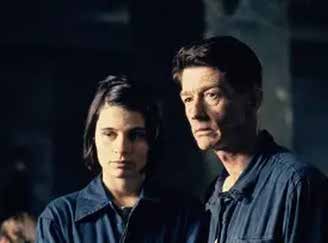
Suzannah Hamilton as Julia and John Hurt as Winston Smith from Michael Radford’s 1984 film
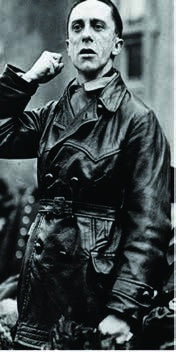
Joseph Goebbels perfected Bernays’ insight. He appears (unnamed) in 1984 in the following: “A little Rumpelstiltskin
figure, contorted with hatred, he gripped the neck of the microphone with one hand while the other, enormous at the
end of a bony arm, clawed the air menacingly above his head.
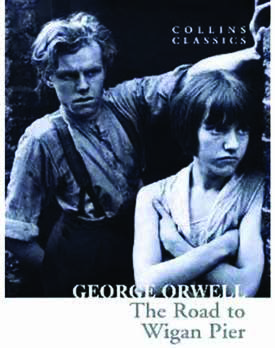
In The Road to Wigan Pier, Orwell looks beyond sentiment to see the slovenly mess of daily life in Northern coal districts. Party socialists entertain imaginary rebellion, but Orwell records only grim endurance.
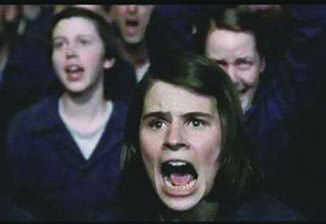
Oceanians find peace in their shared hatred of Emmanuel Goldstein. Vladimir Putin does that for us. He steals children from their parents’ arms to indoctrinate or perhaps to eat them. At the very least he hungers for conquest

We saw this in the US lately when Israeli controllers “doxed” those who protested the Gaza genocide, photographing
offenders and circulating their identities and the label “anti- Semite” to prospective employers. Closed-circuit cameras and cellphones track the movements of an increasingly surveilledpublic. Police wear face masks while the public must show their faces—and the law says so.
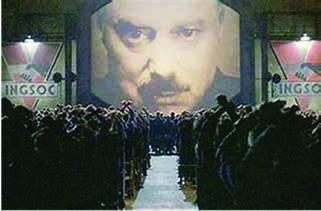
Orwell is one of us … intensely aware that his days are numbered and that he may awake tomorrow to an identity and a new consciousness not quite human. Artist types belong to a peculiar community of the unassimilable, awaiting our absorption into the whole—the group mind in the shared hive of buzzing nonentity.
Darling Julia, our rascally sister, is robbed of her humanity by surgery. Self-reflective Winston is defeated by loneliness and animal terror, but also by a cultural collapse that robs him of all certainty. He has no God, no love, and no community, which may all be the same thing, to arm him against the state.
James Burnham’s The Managerial Revolution terrified Orwell. Its case was forceful, and landed Burnham in Hitler’s logic. Orwell’s socialism feared collectivism. At the same time, socialist revolution depended on the Proles and, therefore, was impossible. The novel ends with the eternal chess match in the Chestnut Tree Café, an existential dead end, in a game we seem to be losing.