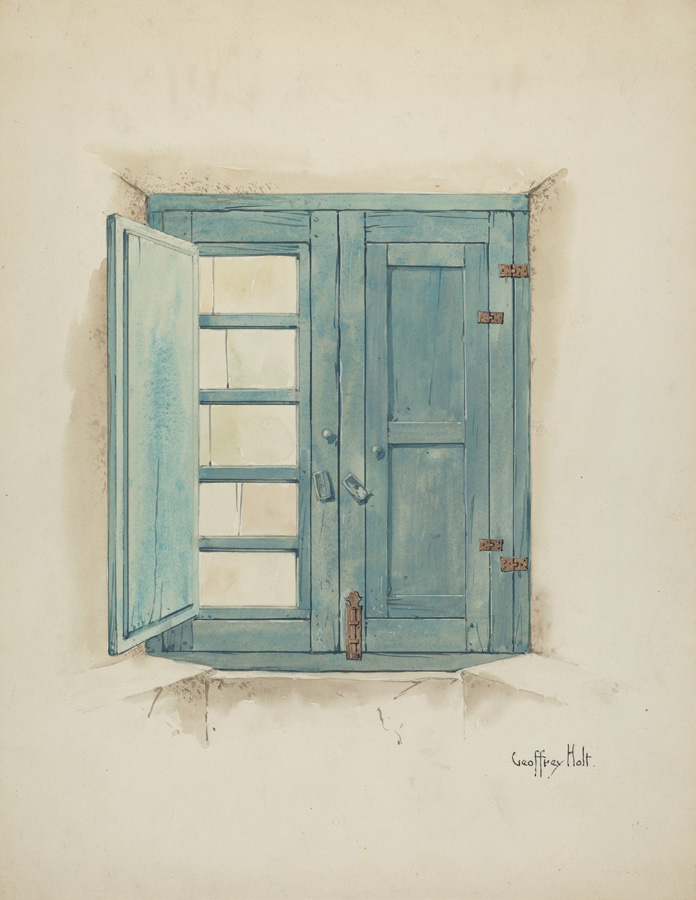
Geoffrey Holt, Original Wooden Shutters from Monastery, 1937.
Index of American Design collection at the National Gallery of Art.
NGA record: Accession 1943.8.6546
I came back to Sheridan Le Fanu almost by accident.
On the 28th of August I was watching ‘The Whisper Man’, newly released on Netflix. And in one of the early scenes a blue-gloved hand came through a letter box but when the protagonist opened the door there was nobody there.
For me it was a Le Fanu lightbulb moment.
Not because I thought the scene had been taken from Le Fanu, nor was I consciously looking for him. It was simpler than that. One image had touched off another stored somewhere in my memory, and suddenly an old friend was back in the room, for his stories are full of things that do precisely that before something half forgotten returns or something concealed becomes visible. Like a sound, a shadow, a hand, a piece of bone: fragments enter an otherwise ordinary world and disturb it because they arrive without the reassuring whole to which they ought to belong.
And perhaps that is where Carl Jung gives us an interesting way of looking at ‘An Authentic Narrative of a Haunted House’. Not because Jung can explain Le Fanu’s ghosts. Le Fanu’s story appeared in 1862, before Jung was born. But place the two imaginations beside one another and an intriguing question appears. What happens when the whole disappears and only the fragment remains?
The House
There is something reassuringly ordinary about Le Fanu’s haunted house when we first arrive.
It stands in a fashionable seaside place. There are gardens and large rooms, servants, children, fires, painted walls and all the familiar apparatus of a respectable Victorian household.
Its narrator has gone there for his health. There is no ruined castle, no family curse, no ancient portrait waiting to move its eyes towards the visitor. Indeed, Le Fanu goes almost out of his way to make the place reasonable.
Then something enters the room. Or perhaps one might say that something already in the house begins to make itself known. This distinction matters. A house is one of the oldest images available to us for the self. There are rooms we occupy every day and others we hardly enter. Public rooms and private ones. Upstairs, downstairs, cupboards, passages and locked doors. We renovate. We repaint. We change the furniture.
Eventually a new inhabitant may know almost nothing about the building that existed beneath the veneer he occupies.
Le Fanu’s house turns out to be precisely such a place.
It appears modern, but near the end we learn that the row of houses had been formed from an old government store, once standing in a much lonelier place — a place, the narrator’s acquaintance observes, perfectly suited to the concealment of a crime.
The new house has been built, in effect, inside the old one. Through a Jungian lens it is difficult not to linger over that. Conscious life likes a renovated building. We box up the old stuff and then we arrange the furniture, light the rooms. And when something untoward occurs we establish sensible explanations. But underneath the new structures, memories, fears, instincts, experiences and associations remain and wait their turn. And turn again they will.
The family thinks it has moved into one house. Gradually it discovers another.
The Missing Body
Le Fanu had already understood something extraordinarily useful to horror: a fragment can be more disturbing than the whole. Elsewhere, in ‘The House by the Church-Yard’, he tells the wonderfully peculiar story of a haunted hand. And only the hand. Le Fanu himself points out the oddity. Its owner is never allowed to become visible. The hand appears while the body to which it should belong remains concealed by doors, curtains, windows or some other convenient obstruction.
That distinction is important. This is not simply a severed hand lying on a table. The body has been removed from the reader’s field of vision. We receive the part and are required to imagine the missing whole.
Something similar happens repeatedly in ‘An Authentic Narrative of a Haunted House’. A shadow appears without the figure needed to cast it. Footsteps are heard without a walker. A door handle moves without a visible hand. A strange red illumination exists without any ordinary source of light. A jawbone comes out of the ground without the rest of the body. A history is suggested without ever becoming a complete history.
Le Fanu breaks the evidence apart. Then he gives the pieces to us. And the reader begins assembling.
Who was murdered?
Who buried the body?
Who is the young woman?
Who is the one-eyed woman?
Who is the man?
Why does the woman continually search the earth?
We are hardly conscious that we have begun doing it.
Le Fanu has made detectives of us.
The Shadow
One of his simplest images may be his strangest.
The cook and housemaid begin seeing the shadow of a woman crossing their bedroom wall. Naturally, they blame the light. So they move the candle. They place it close against the wall, reasoning that nothing can now pass between flame and plaster without becoming visible. For a little while the problem appears to have been solved.
Then the shadow comes back. It crosses the wall even though the physical arrangement of the room says that it cannot be there. So they:nBring the candle closer. Increase the light.nLook harder. But the shadow remains. Jung would later use the word ‘Shadow’ for those parts of the personality that the conscious self does not comfortably recognise as its own.
Importantly, his Shadow was not simply a storehouse for wickedness; Jungian psychology understands it as containing disowned qualities and possibilities more broadly — things excluded from the identity we consciously present to ourselves and others
.
It would be much too neat to announce that Le Fanu’s shadow ‘is’ Jung’s Shadow. It isn’t. But put two images together beside one another and someting happens.
The rational response to darkness is illumination.
Turn on the light.
Move the candle.
Inspect the wall.
Reveal the trick.
Yet Le Fanu gives us a shadow that survives illumination. The more carefully the household arranges the conditions for rational seeing, the stranger the image becomes.
(Last night I closed my bedroom door, and it clicked open again.
I ignored it and then from my bed I watched as it opened a little further, and I switched off and on the light and then in a darkened room I checked to see if my phone light was shifting the dark shades, but then after having nearly convinced myself of a ghostly presence I noticed that the aircon was on, directly over the door lintel! And only then did I drift off into an uneasy sleep. The power of the imagination and a good story intruded for a short time.)
A Light of Its Own
But when Le Fanu reverses the trick, the subconscious no longer merely survives the household light. Just like a camera, it produces an illumination of its own. But maybe our subsconscious is a camera that beams old patterns back into our reality when it recognises a spore or emotion, thereby allowing the past to gain purchase on the present. Maybe it is the master manipulator.
Smith, one of the servants, sees the ragged, one-eyed woman moving around his room as if searching for something. Near her head is an intense glow, deep red, like the fierce light of coal, coming apparently from the hollow of her hand.
It is an extraordinary little image. She does not simply emerge from darkness. She carries something out of it.
Buy now we have two kinds of illumination operating in the story. There is ordinary light: candles, night-lights, daylight, all the apparatus by which people establish where objects are and what they are looking at. And there is this other light. It explains nothing. It belongs to the mystery itself.
That feels close to the territory Jung entered while creating what later became known as ‘The Red Book’.
Following his break with Freud, Jung began recording an intense stream of fantasies and images, first in notebooks and later in the elaborately handwritten and illustrated volume. He did not simply dismiss those images because they resisted ordinary rational explanation; he deliberately stayed with them, recorded them, painted them and asked where they might lead. The Library of Congress describes this period as Jung’s sustained engagement with material arising from his unconscious — an experience he himself regarded as exceptionally difficult. But again, Le Fanu is not Jung. The ghost is not a diagnosis. But the two men share an important respect for the image that has not yet surrendered its meaning. And Le Fanu does not hurry to turn his red light into an answer. He lets it burn.
The Children
The adults carefully avoid discussing the disturbances in front of the children. Le Fanu makes that explicit. The children have not been supplied with a ghost story and so have not frightened themselves into seeing one. Yet they begin seeing things.
Playing outside, they become familiar with a ragged woman near the stable wall. She is apparently so ordinary to them that they do not initially realise there is anything remarkable about her.
And she seems continually occupied with one activity. She searches the ground. Elsewhere, one of the girls sees a strange man entering the nursery and moving about the room. She interprets him as a thief. Another sees a pale young woman with loose dark hair and a dreadful mark across her throat.
What interests me here is not the old idea that children possess some special supernatural sense.
It is something simpler. They see before they explain.
An adult sees the impossible figure and immediately begins constructing machinery around it.
• A hidden entrance.
• A reflection.
• A thief.
• A trick of light.
• A dream.
But the child reports what appeared and by that very fact it creates its own point of reference for the intrusion.
Jung was deeply interested in images arriving before consciousness had reduced them to an acceptable interpretation. Dreams, fantasies, myths and symbols mattered precisely because an image could contain more than the first explanation placed upon it.
Le Fanu’s children have no theory of the house. They possess pieces. And because Le Fanu refuses to tell us with certainty how those pieces fit, we are forced to remain beside them in that uncomfortable space.
What Is Buried
Eventually the children are asked to identify the place where the ragged woman appears.
They agree upon the spot and the earth is opened.
And now the story changes. Until then almost everything might conceivably have remained within perception: footsteps, shadows, figures, knocking, a frightened awakening, an object glimpsed through uncertain light. But the ground produces something physical. Part of a human jaw. Human teeth.
The physicians who inspect them recognise what they are. The fragment has become material and then something stranger occurs. They do not continue digging.
The narrator later admits that he can hardly account for the extraordinary apathy with which he accepted the discovery. Psychologically, this may be one of the richest moments in the entire story. Something hidden has announced itself repeatedly. It has crossed walls. Entered bedrooms. Touched doors. Walked through rooms.
Appeared to servants.
Appeared to children.
Bent again and again over one particular piece of earth. Finally the inhabitants open the ground. And the ground returns a fragment. And they stop.
There is something terribly human about that. We say we want to know. Then knowledge begins appearing. And suddenly not knowing becomes comfortable again.
The Broken Figure
Picasso. This was where another association occurred to me. Le Fanu does not predict Cubism. Picasso and Braque belonged to another age, working within completely different artistic circumstances. But Cubism gives us a useful visual language for thinking about what Le Fanu has done to his story. Picasso could take the familiar human figure and break its reassuring unity into planes, segments and competing viewpoints. The viewer knew there was a woman there, a face there, an instrument there — but had to participate in reconstructing the figure. MoMA describes Picasso’s work of1909 in precisely these terms: heads and bodies fractured into geometric segments, solid volumes broken into shifting planes, traditional single-point representation giving way to several
suggestions of viewpoint at once.
Le Fanu achieves something comparable in narrative — not historically, but imaginatively.
He fractures the event. The hand is separated from its owner. The shadow is separated from its body. The jaw is separated from the corpse. The victim is separated from her history.
The house is separated from its past. The evidence is separated from the explanation. And the reader has to build the missing figure. That may be one reason these old stories remain so effective. If Le Fanu showed us the entire crime — murderer, victim, motive, body and confession — the haunting would contract. It would become a solved case. Instead he gives us fragments. Fragments leave room.
The Divided House
And here Jung returns. One of the unsettling implications of depth psychology is that the conscious “I” is not necessarily master of everything occurring within the psyche.
Ideas arrive unexpectedly. Dream figures speak. Associations form before conscious intention catches them. Emotions buried in the subconscious appear whose causes are not immediately known.
Jung’s own experience during the period that produced ‘The Red Book’ confronted him with precisely that feeling of an inner world behaving with an uncomfortable degree of autonomy.
The self is not one brightly lit room. It is a house. And consciousness occupies only part of it.
Seen this way, Le Fanu’s haunting becomes fascinating without ever needing to cease being a ghost story.
Something has occurred in the house.
The present inhabitants do not know what. The conscious occupants possess no memory of the event. Nevertheless something belonging to the forgotten history continues to behave as though forgetting it has changed nothing.
What has been excluded returns in pieces. First sensation.
Then image. Then repetition. Finally matter. A bone.
A Pretty Puzzle
Near the end, the narrator does exactly what we have been doing. He assembles the fragments.
Perhaps the male apparition was a murderer. Perhaps the one-eyed woman was his accomplice. Perhaps the young woman with the wound across her throat was their victim. Perhaps the woman eternally searching the earth is returning to the place where the body was hidden.
It fits beautifully. Almost too beautifully. And then Le Fanu refuses to certify it. No murderer is identified. No victim receives a name. No document establishes the crime. No confession appears.Nobody digs up the remainder of the garden. The narrator leaves the house. Even more remarkably, he makes no serious attempt afterwards to discover either its earlier or its later history. He calls the whole affair a “pretty puzzle.”
That little phrase saves the story.
The missing whole remains missing. And perhaps that is where Le Fanu, Jung and Picasso can finally sit on the same page without our pretending that they belong to the same argument. Picasso reminds us that breaking the figure apart does not necessarily destroy it. Sometimes fragmentation makes the viewer look harder.
Jung reminds us that an image need not be immediately converted into an explanation in order to contain meaning. And Le Fanu reminds us that a story does not have to return every piece to its proper place. The hand can remain without its owner.
The shadow without its body.
The jaw without its corpse.
The house without its history.
The answer without its certainty.
And sometimes what disturbs us most is not the ghost itself. It is the space where the rest of the figure ought to be.
|