Read this page in: Español Italiano Français Deutsch NederlandsTranslations open from the original English page. To choose another language, return here and select it from the list.

The program Popup.php is being run here but it is not available.


Editors at Work: Editorials/Forewords


On the Scots Language and Its Poetry by James Graham
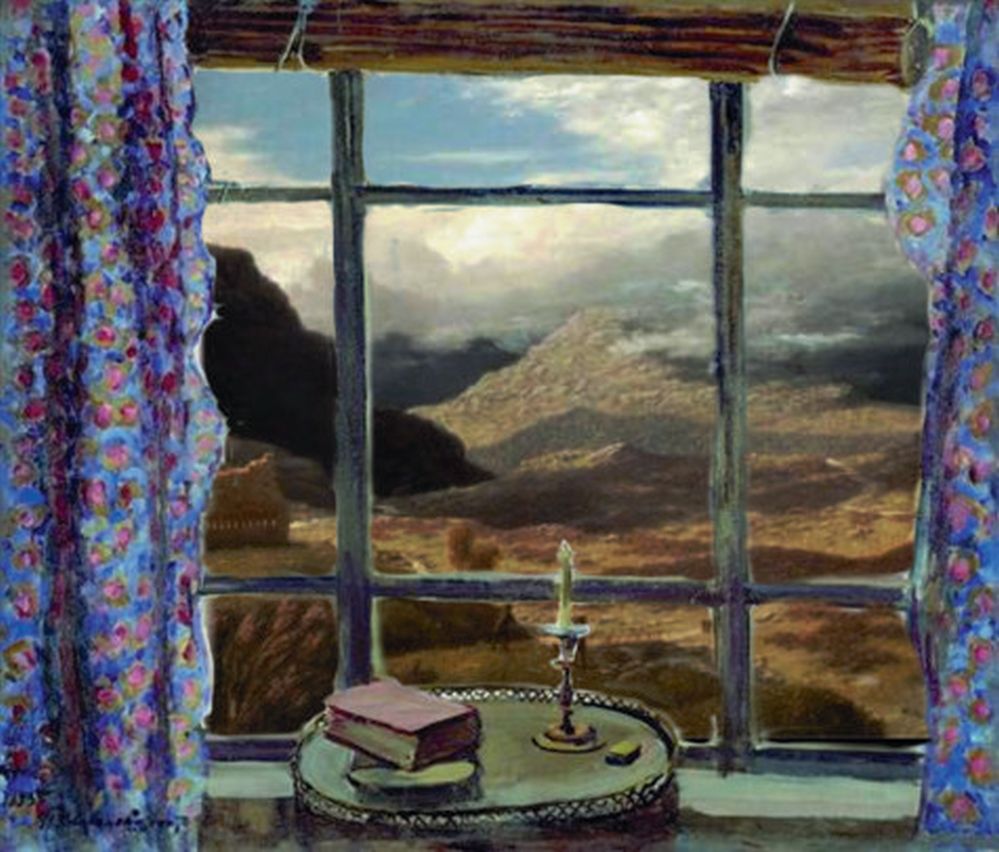
The Poet's Window by Marie Fitzpatrick

'Anent the Scots Leid an its Makars'

In a website I visit from time to time, you can click on such things as Rake, Steid Cairt, and Airtins tae ither Wabsteids. This is the Scots language website Scots Online. 'Rake' could be trendily translated as 'Google' - but literally it's 'search'. The 'Steid Cairt' is the site map, and 'Airtins tae ither Wabsteids' means links to other websites.¹ Such coinage of technical terms in Scots is, to say the least, rather artificial, since no-one says in conversation, ‘D’ye ken the Linnet’s Wings wabsteid?’

The spoken language still exists, mainly in rural areas and small towns, but in a diluted form. It’s not yet a dead language, but it’s not ‘alive’ enough to assimilate coinages and borrowings, and bits and pieces of its vocabulary are easily lost in favour of their English equivalents.

Some would say it’s as good as dead. The trouble is, it won’t lie down. Throughout the twentieth century, right up to the present, there have been writers—especially poets—who have used it in their work, often with astonishing vibrancy. As the spoken language becomes more and more sparse, literary Scots seems to have gone from strength to strength. It is this surprising fact that prompts me to write this essay.

I want to share a few samples of the Scots poetry I love and admire —poetry which is part of the poetic heritage of the British Isles, but may for obvious reasons be a little challenging to those not familiar with the language. Since Scots has been with me since childhood, and I can read it as easily as I read English, it's difficult to know how comprehensible it is to English hearers or readers, or to Americans or Australians. If my notes and translations are too obvious, too spelled out, I apologise. Contrariwise, I hope they're spelled out enough!

First, a mini-treatise on the language. Then the poems.

The Leid

Here's a sample of Scots first of all, a familiar text to give us a flavour of the language. The English version that follows is more or less a literal translation.
1 The Lord is my herd, nae want sal fa' me:

2 He louts me till ligg amang green howes; he airts me atowre by the lown watirs:

3 He waukens my saul; he weises me roun, for his ain name's sake, intil right roddins.

4 Na! tho' I gang thro' the deadmirk-dail; e'en thar, sal I dread nae skaithin: for yersel are nar-by me; yer stok an' yer stay haud me baith fu' cheerie.

5 My buird ye hae hansell'd in face o' my faes; ye hae drookit my head wi' oyle; my bicker is fu' an' skailin.

6 E'en sae, sal gude-guidin an' gude-gree gang wi' me, ilk day o' my livin; an' evir mair syne, i' the Lord's ain howff, at lang last, sal I mak bydan.

1.The Lord is my shepherd, no want shall befall me

2.He makes me to lie among green pastures; he leads me beside the still waters.

3.He awakens my soul; he guides me [round] for his own name's sake, into right paths.

4. No! though I walk through the death-dark valley; even there, I shall fear no hurt: for you are near me; both your rod and your staff keep me very cheerful.

5.My table you have bestowed in the presence of my enemies; you have anointed my head with oil; my cup is full and spilling over.

6.Surely shall goodness [good guidance] and mercy [good reward] go with me, every day of my life; and for ever, in the Lord's own house, at long last, shall I make my home.

This Scots version of the 23rd Psalm, or one very like it, would be commonly heard in churches at any time up to the 19th century. Scots was also the language of the laws and of the law courts—that is, used by judges and lawyers as well as defendants. It was a 'complete' language in the sense that it was used throughout society.

It began as a variant of Northern Anglo-Saxon—just as Anglo-Saxon in turn had begun as a variant or dialect of the Northern Germanic language spoken by the Saxons before they migrated across the North Sea.

Virtually all literature not written in Gaelic was written in Scots. Even in its heyday there was always some vocabulary shared with English, but in the 17th century mutual comprehension between Scots and English speakers would have been difficult.2 Since then its status has declined.

Even so, it's still widely taught in schools, not merely as a salvage operation but much more importantly because of the quality of the literature that has been written in Scots from the late Middle Ages to the present. The literary tradition is so strong that no teacher working in Scotland can reasonably justify its omission from the curriculum. Every teacher of English literature has to be a teacher of English and Scots literature.

During my thirty-odd years of teaching English and Scots, I found that most Scottish schoolchildren enjoyed poems and stories in Scots. For younger children there's a whole genre of 'bairnsangs', and for senior pupils there's the work of Burns, the Scots short stories of Walter Scott and Robert Louis Stevenson, and the astonishingly rich Scots poetry of Hugh MacDiarmid and others in the twentieth century. In the classroom, the language itself presents little difficulty. There are always some obsolete words, or some regional words, that the children don't recognise, but there's always a glossary to help them with these. And even if they don't speak the whole language of the text in front of them, in some indefinable way it always seems a 'natural' language for most of them, like a second language heard and spoken from infancy. In any case their engagement with the stories and poems tends to overcome any linguistic problems that remain.


The Makars - Burns

Arguably the greatest writer in Scots is Robert Burns—though he has his rivals. Despite calumnies that are still sometimes uttered about his supposed drunkenness and promiscuity, Burns is profoundly admired and respected among Scots. The project he undertook in the last years of his life, which he did without payment as a labour of love, was to enrich and secure for all time the heritage of Scottish song.

In a time of failing health, and increasing poverty after he had to give up his farm at Ellisland near Dumfries, he contributed more than 300 songs to two major collections published in Edinburgh—songs that are still sung by professional and amateur singers, in concert performances, at weddings and funerals, and while gardening or doing the housework.

Burns had a genius for a very special art that few poets or composers have been able to master—the rare skill, not of setting a poem to music as Schubert did so superbly, but of putting words to an existing tune.

In just this way, to an old folk tune that could be played on the fiddle he put these words:
Summer's a pleasant time,
Flowers of ev'ry colour;
The water rins o'er the heugh,
And I long for my true lover!
Aye waukin, O,
Waukin still and weary:
Sleep I can get nane,
For thinking on my dearie.
When I sleep I dream,
When I wauk I'm eerie;
Sleep I can get nane,
For thinking on my dearie.
Lanely night comes on,
All the lave are sleepin:
I think on my bonny lad

And I bleer my een wi greetin.
Heugh (pron. hyuch) - rock, crag; waukin - waking; the lave - the rest, the others; bleer - inflame

Burns produced a rich treasury of songs like this - and an equally rich repository of comic and satirical songs.
He was also a great comic writer and satirist. There's no better example of his satire than Address to the Deil, of which a few snippets follow. Remember the poem was written in an age when the Devil was no mere fantasy figure; when a minister could put real anxiety into the hearts of his congregation by telling them Satan was writing in his book the names of all the drinkers, fornicators and intermittent church attenders in the parish. I don't think at that time belief in the actual existence—indeed, immanent presence—of the Devil was anything like universal, but it was widespread.


Burns ironically places under the poem's title a quotation from Milton's Paradise Lost

O Prince, O chief of many throned powers,
That led th'embattled Seraphim to war...
then immediately launches into:
O thou, whatever title suit thee!
Auld Hornie, Satan, Nick, or Clootie,
Wha in yon cavern grim an' sooty
Closed under hatches,
Spairges about the brunstane cootie
To scaud poor wretches!


Clootie- cloven; spairges - splashes (implying, in a clumsy, messy way); brunstane cootie - brimstone bowl; scaud - scald. (A cootie can be several kinds of container, including a chamber-pot. I like to think that was among the meanings Burns intended.)

Satan's 'real name' is included, but the rest are impudent nicknames; and the description of Hell is
a purely comic scene far removed from Dante or Milton. The derisive tone of this opening gambit is pretty clear.

So far the poem's speaker, for all he talks so insolently, nevertheless seems to assume the Devil exists. At the same time the poem is infused with such irony that anyone who so blatantly thumbs his nose at the Devil must be more than half certain of his chimeric status. As the poem develops the 'address' to this shadowy figure becomes much more nuanced. We hear how the Devil appears in many forms, including the Miltonic—as a roaring lion, or riding the 'strong-winged tempest'. This is the fearful creator of all evil, God's adversary, who represents the terror of eternal punishment. Burns gives the Devil a good build-up, especially his capacity to assume cunning disguises; but then comes the deliberate anti-climax:

e dreary, windy, winter night,
The stars shot down wi sklentan light,
Wi you, mysel, I gat a fright
Ayont the loch:
Ye, like a rash-buss, stood in sight,
Wi wavin sugh.
The cudgel in my neive did shake,
Each bristl'd hair stood like a stake,
When wi an eldritch, stoor quaick, quaick,
Amang the springs,
Awa ye squatter'd like a drake,
On whistling wings.

sklentan - shimmering; ayont- on the other side of; sugh- sigh, or the sound of a gust of wind; neive- fist.

I remember one winter night, the poet tells Satan affably, you did give me a bit of a fright, when you assumed the form of a wild drake rustling a clump of reeds (rash-buss) down by the loch and then taking off with 'an eldritch, stoor quaick, quaick' (an unearthly, harsh quack-quack). So with God's adversary now in the form of a quacking duck, we begin to see his power diminishing. In fact ... dare we think the unthinkable? Can it be that it's not Satan in the form of a wild duck in the reeds ... that after all it's only a duck?

Later in the poem Burns gives a lyrical description of Adam and Eve in Eden, and takes the Devil to task for interfering:

Then you, ye auld, snick-drawing dog!
Ye cam to Paradise incog,
An' played on man a cursed brogue,
(Black be your fa'!)
An' gied the infant warld a shog,
Maist ruined a'.

You old cat-burglar, he tells Satan no less amiably than before ('snick-drawing' means stealthily pulling a door-latch or bolt), you entered Paradise incognito, played a filthy trick (brogue) on humanity, gave the infant world a bit of a shake (shog), and ... here's the punch line ... maist ruined a'. Almost spoiled everything. Almost. Burns's Adam and Eve are fellow human beings who should have been left alone to found the human race, without interference from the despicable Auld Hornie - or, for that matter, from the heavy-handed, authoritarian God who evicted them from their beautiful and fertile land. All this egregious meddling, however, could do no more than almost destroy the human spirit. It was a near thing, but less harm was done than we sometimes think.

After casting up a few more of the Devil's misdemeanours, the poet raises the possibility that he himself is bound for Hell.

An' now, auld Cloots, I ken ye're thinkin,
A certain bardie's rantin, drinkin,
Some luckless hour will send him linkin
To your black pit;
But faith! he'll turn a corner jinkin,
An' cheat you yet.
Linkin - hurrying; jinkin - dodging.

As the poem proceeds, Satan is gradually and inexorably reduced to a mere trickster, a con-man. Once you see through him he's finished; he can't wind you up any more. Burns's satire in Address to the Deil - we might say his good humour too, for although it hits the spot it's very genial at the same time, a joshing humour—is an authentic voice of the Enlightenment in an age of superstition.

The Makars - MacDiarmid

In 1925 a young man called Christopher Murray Grieve produced one of those books, like Wordsworth and Coleridge's Lyrical Ballads, after which the literary scene is never the same again. Under the pseudonym Hugh MacDiarmid, he published Sangshaw (Song-festival), which kick-started what has ever since been called a renaissance in Scots literature and language. The influence of this collection of twenty-seven poems, and MacDiarmid's subsequent work over the next fifty years, has been massive. Here's just one of the poems from Sangshaw:

The Watergaw
Ae weet forenicht i the yowe-trummle
I saw yon antrin thing,
A watergaw wi its chitterin licht
ayont the on-ding;
An I thocht o the last wild look ye gied
Afore ye deed!

There was nae reek i' the laverock's hoose
That nicht - an' nane i' mine;
But I hae thocht o' that foolish licht
Ever sin' syne;
An' I think that mebbe at last I ken
What your look meant then.

For readers unfamiliar with Scots, there's quite a lot of explaining to do. But I hope that if I can explain clearly and carefully enough, readers will be able to appreciate this short poem which uses the Scots language so immaculately, and must surely be one of the finest modern lyrical poems in any language.

Stanza 1. The first line needs a careful commentary. 'Ae weet forenicht i the yowe-trummle' - One wet early evening during a cold spell just after the sheep-shearing. The 'yow-trummle' (literally 'ewe-tremble') is, or used to be, a common country expression—like 'Indian summer' but a sort of opposite to that, a cold spell in Spring when the poor shorn sheep were exposed to bitter winds.

The rest of the stanza translates: I saw that fleeting thing, a rainbow with its shivering light, beyond the rain-squall; and I thought about the last wild look you gave before you died.

Stanza 2. "There was nae reek i' the laverock's hoose/ that nicht, an' nane i' mine' - there was no smoke in the skylark's house/ that night, and none in mine'. The skylark's house could be its nest, or it might be the sky, that 'most excellent canopy, the air' where the lark is so much at home. If there's smoke, there's a fire—maybe a peat-fire; there's warmth, food and drink, and company. All's well. But the night she died all the joy seemed to have gone from the poet's house, from his heart, even from his natural surroundings.

But that light, and the poet's feelings about it which he thought foolish at the time, have never left him. And because of it, he begins to understand that last look she gave.

'What your look meant then' is ineffable; any attempt to give a pat answer to the question 'What did it mean?' would fall short not only of the poem's meaning, but of its depth of feeling too. 'I know what your look meant' is an intuitive knowing. It is bound up with the rainbow, the storm, our joy of living in the world and our grief at leaving it - and that remarkable thing that sometimes happens to us when something accidental, something observed in a passing moment, becomes an epiphany.

As much as anything else, it's the astonishing quality of work like this in Scots that keeps the language alive. In the far future, even if nobody speaks it any more than Chaucer's English is spoken now, the work of the makars is unlikely to be forgotten.

***

¹ For those who are as intrigued by words as I am, here's a lengthy but fascinating footnote. The everyday use of 'rake' in Scots refers to looking for something among a whole lot of other stuff, say in a drawer; you rake with your fingers to try to turn up the thing you're looking for. The Scottish National Dictionary gives this meaning, but also the meaning 'to look into, to investigate'.

(On Gaelic websites, 'Search' is 'Rannsaich', pronounced 'ransach' or 'ransack' if you can't manage the 'ch'. The Gaelic and English words have the same Old Norse origin in 'rannsaka', literally a house search. It's not hard to imagine what a bunch of Vikings just off the longboat meant by a 'house search'. In these more civilised times we can all rannsaich the Internet for information - yet another word for Google.)

The word 'steid' is not far removed from 'stead' as in 'homestead'. In Scots usage, however, it tends to mean a site on which a building is to be erected.

'Cairt' is related to the 'cart' in 'cartography', and to 'chart'. The English and Scots words have their common root in Latin carta, a sheet of paper or parchment. But for a sheet of paper with roads, rivers and towns marked on it, English has used the word 'map' from Latin 'mappa', originally meaning a printed or painted cloth such as a towel or napkin.

'Airtins' is the least recognisable word, as it derives from the Gaelic for 'quarter', i.e. compass point. In Scots it means a direction, or a route taken on a journey.

² How different are languages? Some languages are cognate: much of their vocabulary is from the same origin. English is basically a Germanic language, with of course many words taken from Latin, Greek and a host of other languages. So, as far as simpler words are concerned, we can guess that Mann is man, and Maus is mouse, and even Strasse is street.(Though Dutch 'straat' is closer.) So we have to say that English, Dutch and German have words in common, any variations in spelling and pronunciation being not enough to prevent us recognising that they are the same words.
English: My house is next to the church. Dutch : Mijn huis is naast de kerk. German: Mein Haus ist neben der Kirche. Scots: My hoose is neist tae the kirk. A family of languages?

3 Burns's language in this song looks more English than it sounds. All the best singers of Burns songs give words their characteristic Scottish pronunciation, e.g. (in the first verse) simmer, pleesant, flooers, watter. 'O'er' is pronounced 'ower' rhyming with 'tower'. In Address to the Deil, note especially the sound of the rhymes nicht, licht, fricht, sicht (spelt night, light, fright, sight). The vowel sounds in these words are also different from English - not long 'i' as in 'bite', but short 'i' as in 'bit'.

- James Graham.
Acknowledgement: Many thanks to "Carcanet Press" for allowing publication of "The Watergaw" by Hugh MacDiarmid


Big Plans by Nonnie Augustine

Jane was propped up on her elbows, eating a slice of pizza and trying not to get sauce on her friend's bed. Caroline, sitting at her computer with a slice in hand, complained yet again about submission guidelines.

"They all say the same thing. So boring. Twelve point type, no fancy fonts, word counts need not include the title, blah, blah, blah. Editors are all the same. I've discovered a brilliant font. I swear it's art in itself, but it's not one of their blessed regulars."

"Really? Did it come with that font software you bought? What's it called?"

"Yes, really. Yes, it did. And it's called 'Mondrian Whirl.' Totally cool. Here's my new poem printed in it."

'I Felt so Alone.'

"Hey, wasn't that the name of the last poem you wrote?"

"No-o. That was called, 'Loneliness is Misery."'

"Ah. My bad. But you do write about feeling lonely on Sundays in both, don't you?"

2008 Nonnie Augustine


Summer 15: The Cat and the Moon by Oonah V Joslin

-- and what it meant to Me (Poetry Editorial,)
by Oonah V Joslin


When I was little I had difficulty learning to read, partly because of left/right handed confusion, partly because I had a teacher from hell who used to pull my plaits when I made a mistake and maybe because it was around that very time my father died and upset the whole applecart. However it may be, all through junior school that part of the day when you went up and chose a book and read silently was a torture for me. But it led me to poetry. Poetry was short enough you could just dip in. Poetry had rhythms and rhymes that helped with difficult words (though I remember consistently reading 'phase' as 'face' in this poem.) Poetry painted pictures in my head that replaced all those confusing symbols with sounds and you could make up your own stories round it.

Recently I decided to repair an appalling gap in my reading and picked up a collection of Yeats’ work in a second hand book shop. We'd 'done' a few poems by Yeats at school but not many. However I wasn’t far into it before I recognised an old friend and I sat grinning with the book in my hand and remembered reading this one poem again and again (until the teacher spotted that I’d been in the same book for months that is) and the sheer delight of it because I loved cats and the moon and could see Minnaloushe pouncing about in moonlit pools.


The cat went here and there
And the moon spun round like a top,
And the nearest kin of the moon,
The creeping cat, looked up.
Black Minnaloushe stared at the moon,
For, wander and wail as he would,
The pure cold light in the sky
Troubled his animal blood.
Minnaloushe runs in the grass
Lifting his delicate feet.
Do you dance,
Minnaloushe, do you dance?
When two close kindred meet.
What better than call a dance?
Maybe the moon may learn,
Tired of that courtly fashion,
A new dance turn.
Minnaloushe creeps through the grass
From moonlit place to place,
The sacred moon overhead
Has taken a new phase.
Does Minnaloushe know that his pupils
Will pass from change to change,
And that from round to crescent,
From crescent to round they range?
Minnaloushe creeps through the grass
Alone, important and wise,
And lifts to the changing moon
His changing eyes.

by W B YEATS

And I remember thinking at the time that though the cat loved the bright moon and the moon shone down on the antics of the black cat, they could never really meet and understand each other. She is beautiful sacred and pure and very far above him and he will never be interested in dancing but only in hunting. Though they meet in the night, they really don’t understand each other’s natures or their own. It’s only the night they have in common, only the night that connects the two. They are both changeable and proud in their own way but they cannot accommodate each other.

Of course there is a lot more to the poem than that. A child can read it but it’s far from a children’s poem. Study it for yourself. The rhymes tend toward assonance and the rhythm inevitably breaks down. It’s a dance that cannot be. I knew nothing about Maud Gonne or Yeats himself or the moon’s 28 day cycle or much at all about anything (I think I was about ten). But that expression of solitude gave voice to something I sensed but didn’t understand, just as they didn’t understand; the nature of connectivity and individuality; the need to be alone commingled with the desperate longing to belong. The picture always remained in my head even though I didn’t know who’d written the poem. A great story of love and loss. And a good deal shorter than Anna Karenina!


Couplet Prologue, Summer 2015

Summer Couplets

Angels tune harps to small birds' tweets
While crows fix beady eyes on tasty treats
MLF

Summer displays directions
On footpaths of reflections
MLF

Happy is summertime all year round
The present is where happy is found
MLF

Summer creates scenes of fun and laughter
Joy and love and happy ever after
MLF

Summer scolds the pavement with its heat
Folks show tanned skin from head to bare feet
GH

The roar of May Bank Holiday
Motorbike psychology
OVJ

The worker's role we celebrate
Oh, what fun it generates
MLF

Summer came early and brought her toys to play
Sunlight and heat, she builds throughout the day
GH

Borodin conducted Liszt
Later, Mercury composed work they missed
MLF

Summer's musical number
Knit through man-made wonder
MLF

Summer whispers during Mercury retrograde
Communication errors will definitely be made
GH

Summer's love is clear and bright
It's communication at its might
MLF

Summer sun beats down relentlessly
He bakes the land and boils the sea
GH

When rag-and-bone men made their play
Lads and lassies, well! they made hay
MLF

A churning sea now settles down
For sun and fun as life rebounds
MLF

Summer clears away the cobwebs of my mind
And exposes dark corners -- what will I find?
GH

Well done to Spring, she cleared webs out,
Now Summer calls: a bottle of stout
MLF

I found in summer my life's refrain
This kiss of joy brought many gains
MLF

Exotic jasmine dances in on summer breezes
She caresses my face -- my soul she teases
GH

Sun scents sound, in air so still,
And seeds beauty for one's mind to refill
MLF

A tease, a dance, a summer breeze
Enough to create hearts of ease
MLF

Those damned birds singing at the screech of dawn,
Yawn, yawn, yawn, yawn, jaw-breaking YAWN!
OVJ

That early, easy bird song awakes
Oh man, oh man, I LOVE summer daybreaks
MLF

What light through yonder window shines?
It is the sun? Yawn, yawn!
OVJ

Let me up and out, there's road for action
This day ahead brings perfecto faction
MLF

Summer days, a freckled haze
Hide from those ultraviolet rays
OVJ

Just great, sunscreen down in the shop
It's sixty-, seventy-degree sunblock
MLF
(
Writers: Oonah Joslin, Mari Lynam Fitzpatrick and Ginger Hamilton (Writing on Facebook, Spring 2015)


Seamus Heaney: An Archaeologist of the Soul by Oonah V Joslin

Foreword Autumn 2013

They asked me to write something about Seamus Heaney and I thought, 'Who am I to do that? Sure, he’d never heard of me and I never met him.’ Still, when he died I felt sorrow for the loss and referred to him as a great poet and fellow countryman and I recommended people read Beowulf. Then I thought, 'Maybe my reaction itself bears some scrutiny.’

Great poet, undoubtedly. Such men never really leave us. Fellow countryman? You take the Ahoghill Road from Ballymena through Portglenone to Bellaghy and it’s only about twelve miles. But twelve miles and fourteen years and Heaney’s Ulster was a bit different from mine. He was a Catholic from County Londonderry (which he would have called Derry). I was Ballymena Baptist with 'orange’ blood in my veins.

And why Beowulf?

Heaney was out and out, an Irish poet and I do not consider myself so. In Ulster parlance we dug with the opposite foot. So let us pick our way you and me, over this splintered field of broken green glass and find out what made us fellow countrymen.

I’d picked up Beowulf before and tried to read it, not in its original form of course. Much as I wanted to, I couldn’t get on with it at all. I’d studied French as Heaney did and it seems we’d both cut our teeth on Hopkins and Eliot at school. We had that in common. Heaney however had the benefit of learning Gaelic because his education as a Catholic was culturally Irish so he developed a broader linguistic palate. Yet for him the language of Ulster was riches enough.

When I picked up Heaney’s new translation and read: “Afterwards a boy-child was born to Shield, a cub in the yard, a comfort sent by God to that nation. He knew what they had tholed, the long times and troubles they'd come through I grinned. “tholed" is just the word I would have used but it apparently comes from an old English word that begins with a letter shaped like a thorn.

I read on.

“That was one good king"

I smiled again. Later on there was:

“hirpling with pain,-- and there was “blather," and “gumption," and “hoked," and I read on and on delighted by the little treasures of my past.

I read about the great hall:
“The hall towered,
its gables wide and high and awaiting
a barbarous burning. That doom abided,
but in time it would come:
the killer instinct unleashed among in-laws,
the blood-lust rampant."

and I knew that he was talking about all divided peoples everywhere.

It was only later that I read in the introduction where Heaney talked about his family, the Scullions and their voices and words that had woven their way into this poetic narrative. He wrote that:

“The place on the language map where the Usk and the uisce and the whiskey coincided was definitely a place where the spirit might find a loophole, an escape route from what John Montague has called, 'the partitioned intellect’

That struck a chord with me. I know the River Usk too having lived in Wales. But you see

I do not consider myself an Irish poet. I am not an English poet either. I could perhaps be termed a Scot in the original sense of that northern part of Ireland being where the Scots came from (the Picts being from Scotland). Maybe going back far enough, I could call myself Dalriadan, being from part of that ancient Northern Kingdom that encircled the Western Isles. There is this innate identity crisis in all subjugate peoples; divided loyalties, cultural chasms, religious rifts and it’s difficult to find where you stand in an entrenched landscape dug by history. As I have said before, “difference is very persistent in getting the upper hand'

Heaney promised he’d dig with his pen but for me he did more than that. There’s digging and digging. Some people dig nothing but dirt, others dig graves and there has been a lot of that in Ireland’s history. Seamus Heaney endeavoured, like so many of us, to be part of the solution not the problem. In digging deep within the roots of our language, he excavated for us a rare treasure; the key of a kingdom. He reinterpreted the map of, as he put it:

“that complex history of conquest and resistance, integrity and antagonism… ..that has clearly to be acknowledged by all concerned… if we are to move forward.

Well, I shifted my position a bit and I owe him that. For is it not true that no matter who we are, we have far more in common with each than the total sum of our differences? He did the spadework for me. I understood Beowulf and myself and my history a bit better and in the splintered landscape of broken green glass, I look up and there are the old signposts: Ahoghill, Portglenone, Bellaghy with such familiar sounds and maybe next time I'm home, I’ll visit.

Thank you my fellow countrymen at The Linnet’s Wings for the privilege of paying this little tribute.


###

"Now he belched forth flaming fire."/An illustration of Beowulf fighting the dragon that appears at the end of the epic poem./Marshall, Henrietta Elizabeth (1908) Stories of Beowulf, T.C. & E.C. Jack, p.93

Oonah V Joslin is managing editor at Everyday Poets: www.everydaypoets.com


Prologue Summer 2013: Tender Buttons Gertrude Stein -- 1914

FOOD
SALAD DRESSING AND AN ARTICHOKE.
It was please it was please carriage cup in an ice cream, in an ice-cream it was too bended bended with scissors and all this time. A whole is inside a part, a part does go away, a hole is red leaf. No choice was where there was and a second and a second.

CAKE.
Cake cast in went to be and needles wine needles are such.

This is today. A can experiment is that which makes a town, makes a town dirty, it is little please. We came back. Two bore, bore what, a mussed ash, ash when there is tin. This meant cake. It was a sign.

Another time there was extra a hat pin sought long and this dark made a display. The result was yellow. A caution, not a caution to be.

It is no use to cause a foolish number. A blanket stretch a cloud, a shame, all that bakery can tease, all that is beginning and yesterday yesterday we had it met. It means some change. No some day.

A little leaf upon a scene an ocean any where there, a bland and likely in the stream a recollection green land. Why white.

APPLE.
Apple plum, carpet steak, seed clam, colored wine, calm seen, cold cream, best shake, potato, potato and no no gold work with pet, a green seen is called bake and change sweet is bready, a little piece a little piece please.

A little piece please. Cane again to the presupposed and ready eucalyptus tree, count out sherry

and ripe plates and little corners of a kind of ham. This is use.


OBJECTS
BOOK.

Book was there, it was there. Book was there. Stop it, stop it, it was a cleaner, a wet cleaner and it was not where it was wet, it was not high, it was directly placed back, not back again, back it was returned, it was needless, it put a bank, a bank when, a bank care.

Suppose a man a realistic expression of resolute reliability suggests pleasing itself white all white and no head does that mean soap. It does not so. It means kind wavers and little chance to beside beside rest. A plain.

Suppose ear rings, that is one way to breed, breed that. Oh chance to say, oh nice old pole. Next best and nearest a pillar. Chest not valuable, be papered.

Cover up cover up the two with a little piece of string and hope rose and green, green.

Please a plate, put a match to the seam and really then really then, really then it is a remark that joins many many lead games. It is a sister and sister and a flower and a flower and a dog and a colored sky a sky colored grey and nearly that nearly that let.

A TABLE.
A table means does it not my dear it means a whole steadiness. Is it likely that a change.

A table means more than a glass even a looking glass is tall. A table means necessary places and a revision a revision of a little thing it means it does mean that there has been a stand, a stand where it did shake.

A CHAIR.
A widow in a wise veil and more garments shows that shadows are even. It addresses no more, it shadows the

stage and learning. A regular arrangement, the severest and the most preserved is that which has the arrangement not more than always authorised.

A suitable establishment, well housed, practical, patient and staring, a suitable bedding, very suitable and not more particularly than complaining, anything suitable is so necessary.

A fact is that when the direction is just like that, no more, longer, sudden and at the same time not any sofa, the main action is that without a blaming there is no custody.

Practice measurement, practice the sign that means that really means a necessary betrayal, in showing that there is wearing.

Hope, what is a spectacle, a spectacle is the resemblance between the circular side place and nothing else, nothing else.

To choose it is ended, it is actual and more than that it has it certainly has the same treat, and a seat all that is practiced and more easily much more easily ordinarily.

Pick a barn, a whole barn, and bend more slender accents than have ever been necessary, shine in the darkness necessarily. Actually not aching, actually not aching, a stubborn bloom is so artificial and even more than that, it is a spectacle, it is a binding accident, it is animosity and accentuation.

If the chance to dirty diminishing is necessary, if it is why is there no complexion, why is there no rubbing, why is there no special protection.

A FRIGHTFUL RELEASE.
A bag which was left and not only taken but turned away was not found. The place was shown to be very like the last time. A piece was not exchanged, not a bit of it, a piece was left over. The rest was mismanaged.

ROOMS
A light in the moon the only light is on Sunday. What was the sensible decision. The sensible decision was that notwithstanding many declarations and more music, not even notwithstanding the choice and a torch and a collection, notwithstanding the celebrating hat and a vacation and even more noise than cutting, notwithstanding Europe and Asia and being overbearing, not even notwithstanding an elephant and a strict occasion, not even withstanding more cultivation and some seasoning, not even with drowning and with the ocean being encircling, not even with more likeness and any cloud, not even with terrific sacrifice of pedestrianism and a special resolution, not even more likely to be pleasing. The care with which the rain is wrong and the green is wrong and the white is wrong, the care with which there is a chair and plenty of breathing. The care with which there is incredible justice and likeness, all this makes a magnificent asparagus, and also a fountain.

A religion, almost a religion, any religion, a quintal in religion, a relying and a surface and a service in indecision and a creature and a question and a syllable in answer and more counting and no quarrel and a single scientific statement and no darkness and no question and an earned administration and a single set of sisters and an outline and no blisters and the section seeing yellow and the centre having spelling and no solitude and no quaintness and yet solid quite so solid and the single surface centred and the question in the placard and the singularity, is there a singularity, and the singularity, why is there a question and the singularity why is the surface outrageous, why is it beautiful why is it not when there is no doubt, why is anything vacant, why is not disturbing a centre no virtue, why is it when it is and why is it when it is and there is no doubt, there is no doubt that the singularity shows.
A whole soldier any whole soldier has no more detail than
any case of measles.

A bridge a very small bridge in a location and thunder, any thunder, this is the capture of reversible sizing and more indeed more can be cautious. This which makes monotony careless makes it likely that there is an exchange in principle and more than that, change in organization.

This cloud does change with the movements of the moon and the narrow the quite narrow suggestion of the building. It does and then when it is settled and no sounds differ then comes the moment when cheerfulness is so assured that there is an occasion.

A plain lap, any plain lap shows that sign, it shows that there is not so much extension as there would be if there were more choice in everything. And why complain of more, why complain of very much more. Why complain at all when it is all arranged that as there is no more opportunity and no more appeal and not even any more clinching that certainly now some time has come.

A window has another spelling, it has "f" all together, it lacks no more then and this is rain, this may even be something else, at any rate there is no dedication in splendor. There is a turn of the stranger.

Dance a clean dream and an extravagant turn up, secure the steady rights and translate more than translate the authority, show the choice and make no more mistakes than yesterday.

This means clearness, it means a regular notion of exercise, it means more than that, it means liking counting, it means more than that, it does not mean exchanging a line.

Why is there more craving than there is in a mountain. This does not seem strange to one, it does not seem strange to an echo and more surely is in there not being a habit. Why is there so much useless suffering. Why is there.

center>###

(Prologue Summer 2013)


Art Editorial Summer 2013
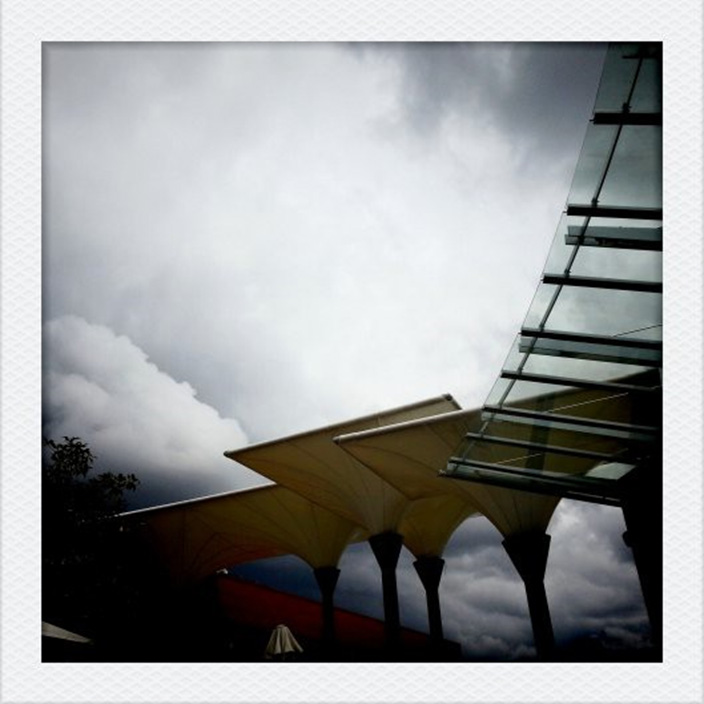
Thiais Village Credit: (c) Gabriel Mtz. Aguirre

(c) Gabriel Mtz. Aguirre

Photo Gallery: Summer storms . . . .
are usually not our first association to this season of sprawling daylight hours. Summertime, after
all, is when "the livin' is easy." It's when we re­connect with the nearly forgotten sensation of
bright, hot sunshine and fresh air playing on our bared skin, just before thrilling to the splash of
cooling water. We envision bright blue skies, a beaming solar disc, and perhaps a few wisps of
high lofting clouds. Pleasurable, to be sure, but far from a full or complete picture of the season.
To round that out, we asked our contributing photographers to share their views of the darker,
moodier side of summertime skies, from Paris to the heartland of the American Midwest, where
nature has been wont to put its massive powers on display. Our thanks to Gabriel M. Aguirre,
Frank S. Hutton, Gina Kelly and C. Mannheim for expanding our repertoire of seasonal imagery
throughout the pages of this issue. [We also welcome Peter Berman's first time, videographic
contribution to LW's on­line edition.*]

Maia Cavelli


I Agree With William Blake by Nonnie Augustine

“Poetry fettered, fetters the human race. Nations are destroyed or flourish in proportion as their poetry, painting, and music are destroyed or flourish."


William Blake died in 1827, well before the rise of Hitler, Stalin, Franco, or Mussolini. But he knew, Artists do not flourish, at least not openly, when under the thumb of repressive regimes. Artists draw the eye and ear toward kindness, toward the careful tending of small things, toward the freedom each of us needs in order to flourish. I expect I'm preaching to the choir here, because you are reading this magazine, and so, I believe, you already value art, and because you are reading this introduction to the poetry section of The Linnet’s Wings, you read poems. (Somehow many people don’t, you know.)

How awful life would be, how fettered, if all we had to read were White Papers, financial reports, news of war here and there and everywhere, or heaven help us, the dictates of an autocrat. Have you heard Jimi Hendrix’s version of The Star Spangled Banner? It’s beautiful, heartfelt, and utterly free. There’s also warning in this version of the anthem; he’s rallying us to never let our guard down and always to look for deeper meanings even in something we think is established and therefore completely known. Artists do that for us, whether they lived centuries ago, or are just starting out with their brave, tender voices.

Let me point you toward some of my favorite bits in this issue’s crop of poems:
“Joe’s dovecote/ was a narrow spartan shed/ enough for/ thirty racing pigeons/ cozy on their perches"
Stan Long

“ The atmosphere of Scandinavian coolness/ is tempered by the Japanese aroma/ and visual pleasure of the cavalcade/ of ancient sacred food" John Saunders

“the fathomless deep greens/of fir and spruce, steadfast/ throughout the harsh resentment of winter"
Anne Britting Oleson

“When all of the jobs/ dried-up, you/ helped me sew together/ the pieces of my broken spirit./ Having faith in your own words, in us." Ivy Page

“From inside the closed balcony door the cat watched/ with surprising calm./ My heart beat too was calm./ For a short while I knew everything, with certainty." Beate Sigriddaughter

“that austere boyhood near London,/ lamp-posts disappear into fog,/ images reminiscent of Whistler." Ian C. Smith


As you know, in the U.S. we just went through a bitter campaign season and finally re-elected Barack Obama for a second term as our president.


I am relieved for many reasons, but mostly because I was so disturbed by the other guy and his cronies. In what they said, did for their livings and by how they measured success, I knew. I knew.

These are not men (almost all of them are men) who value the words of poets. They'd not relate to pigeons, cozy in a spartan shed. I do. I’ve been warm and content in the most drear circumstances while a student at Juilliard.

I sense that these politicians, so proud of their success as businessmen, might purchase a Whistler but only as an investment; a status symbol. Not me. I would go to a museum to sit happily in front of one of his paintings and maybe, for a short while, I would know everything.

The Linnet's Wings is free to you online. I hope some of you will buy print copies because they are beautiful. We editors commit to each issue our unfettered spirits and we bring you the work of writers who speak to us without fear, with their best, and in their belief that through art we all will flourish.


###


Poetry Editorial: A Mother Knows by Oonah V Joslin
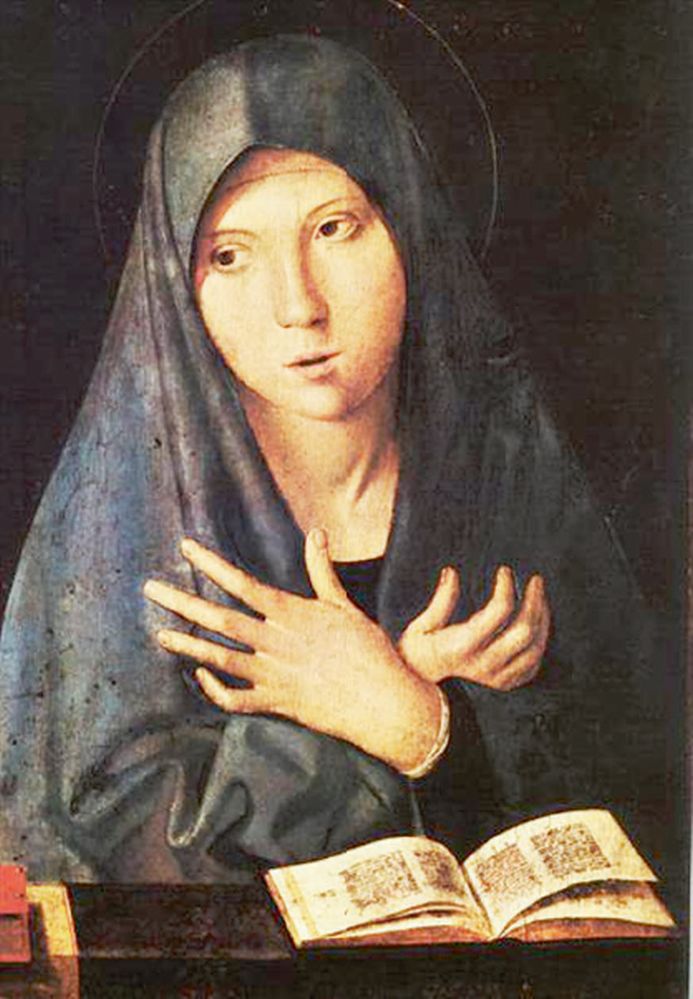
Virgin of the Annunciation by Antonello Da Messina

Autumn 2013

I've never been to Mexico City and I am not a mother. Perhaps that is why “A Mother Knows” grabbed me by the throat and will not let go. Sometimes that which is most alien to us is best understood through poetry. Poet Pippa Little's son Jack lives, teaches and publishes in Mexico (Ofi Press) and so she has had ample experience of the sensory onslaught or as she calls it the

'mad life which makes living contagious.' – Ex Voto,

Pippa's chapbook “our lady of the iguanas” is one of the biggest little books I've ever read. It samples the rich and colourful life of Mexico – its culture, food and magic. Magic permeates these poems, magic and myth. Perhaps that is because Mexico's culture is a product of syncretism – a laminate of new ideas over old.

In these poems we find ourselves inhabiting a land of relentless stimulation as in 'Metro/Bus'. Ancient and modern ritual are at once, familiar yet strangely changed as in 'Day of the Dead' and hideous – yes hideous contrasts emerge from the pages, as when Santa Muerte, stubs out her cigarette in an ocelot made for a human heart in 'Zocola'. We are bewildered by these emotions, and like Pippa, we too become the 'Mute stranger in the middle' -- 'Hen Party''.

There is birth, life and rejuvenation in these pages – and spoons. Art and absence. Sometimes a sense of nihilism leads to the almost suicidal celebration of life described in 'Cliff Divers, Acapulco' and Quetzalcoatl is never far away in modern Mexico as is evident in 'The Alarma!Man and Me'. Underpinning life it seems, is death, and over all presides the mother figure –our lady – often transmogrified into whatever face she needs to appease the practises of more ancient rituals.

In 'But The Poor Remain And The Sky' a poem title quoted from an essay by supreme nihilist Albert Camus, we are reminded of the Absurdist view of God and the Devil. This is a land of great beauty and struggle as in Camus' works – a world where death awaits from the moment of birth and where light may clarify but also deceives. The gods are cruel.

A Mother Knows
La Santisima isn't soft brown as a blown rose,
all Virgin of Guadalupe: she is white bone.
Skull and skeleton, womanised by tumbling horsehair
she carries a razor-sharp scythe and full set of teeth
bared in a grin. They dress her in lace and gold silk,
layer after layer. Fold upon fold, surround her with lilies
but she is not beautiful, nor does she want to be.
It is not beautiful to be hungry, to sleep on the street,
to rob at gunpoint, to crave the sad dreams of solvents.
She wants you to come to her on your knees, offer
what is most necessary to you – tequila, cigarettes, money,
anything is acceptable but shame. I will give you a good death
she whispers through clenched jaws. Die hard and slow,
alone, or die with me. A mother knows.

What does a mother know? The glib answer is 'best.' But this mother is never glib. She's deadly serious. In this case, knows the truth, the always brutal truth, about how wonderful and terrible life is and that joy and suffering are integral to life. A mother especially knows her children are born to die. She knows the vast absurdity and the yet utter worth life. And whilst one feels prickles of nihilism here, what ultimately comes across, is a kind of courageous realism that is always part of Pippa's palatte.

This is accomplished not only in words but in sound. In this poem the soft and hard stand side by side in s's and b's
La Santisima isn't soft brown as a blown rose

The Lady of Guadalupe referred to here as the blown rose, cured the sick. She is all about life. No, this is Santa Muerte – the lady of death – a skeleton which must be womanised and that is achieved verbally by language as languorous as it is soft.

They dress her in lace and gold silk,
layer after layer. Fold upon fold, surround her with lilies

They dress her. This is church-dressing, spiritual dressing, grave dressing. She is clothed in the non-indigenous veneer of comforting Christianity.

but she is not beautiful, nor does she want to be.

Muerte is the lady of the poor, the underprivileged, the hopeless. And as Pippa points out
It is not beautiful to be hungry, to sleep on the street,
to rob at gunpoint, to crave the sad dreams of solvents.

Soft sounds contrast here with harsh life but there is no sense of self-pity or of these people being victims. Note that these are not people who are robbed at gunpoint but who 'rob at gunpoint'! They are survivors. They do what they have to do, get on with life, like Camus' poor who are left in the city in the summer – for whom the brutal heat is an inescapable reality. Nor is there any hint of shame in being poor. Indeed
anything is acceptable but shame

There is contrition. There is a price to pay for this cold comfort offered by the church and it is in the recognition that all must die and Santa Muerte offers no escape from that.

She wants you to come to her on your knees, offer
what is most necessary to you

and she whispers the words, as in a confessional – soft words with a very hard message:

Die hard and slow,
alone, or die with me.

Nor does she offer salvation. All she has in her gift is
a good death.

So I ask again – what does a mother knows? Well this one's a skeleton – she knows how to die. She's done it. And isn't there a hint of Eve about this knowledge? It carries with it the loss of innocence, her testimony to the naked truth. She bares witness that life is a struggle and that we have no choice. This is one of the bravest of the brave poems in this book. They are poems you can live in. You may believe Pippa – she's a mother.
“our lady of the iguanas” is published by The Black Light Engine Room 2016

12 Harrogate Crescent
Middlesbrough
TS5 6PS
UK
theblacklightenginedriver@hotmail.co.co.uk


Slightly Mushy Essay About Poetry and Peaches by Nonnie Augustine

Indigo Frontis, The Linnet's Wings House Art

"Do I dare to eat a peach?" is a line in the penultimate stanza of T.S. Eliot's "The Love Song of J. Alfred Prufrock." He wrote it sometime before 1920, when it was published; I read it sometime around 1973 ; it has lived with me ever since. The line comes up, you know? Along the way, as I've done this or that, it's surfaced, throughout my adult life-as have other bits from this or that poem, but I'd have to go on and on and on to talk about all of them, and we don't want that. No. Just Prufrock's peach. Why has it stuck with me is what I'm wondering about here.

Great peaches are messy, juicy, risky. Then there's the fuzz. What to do about that? Decisions abound. To peel? To cut? Is a knife at hand or will I have to ask for one? Maybe I should skip this fuzzy, juicy, delicious-looking peach. Eat something else… what to do? Do I dare? Well, I have. And have not.

I've messed up a lot of clothes, of course, and washed many dribbles off my chin. I've gone all out and been astonished. Sometimes I've done without, skipped the burst of flavor, the pleasure, because I've lacked nerve. Sure, I have. We all have.

I imagine T.S.'s line about J. Alfred's peach will continue to pop up as I move on in life, even if I'm not trying to get ahead with quite so much oomph. There's still risk-plenty of peaches to consider. I've had, and will have, poetry within easy reach, and some of it right there behind my eyes, between my ears, oh, hell, in my heart and soul.

So, when you write (when I write) it is (I tell myself) always worth trying to go for those phrases, lines, stanzas that might move right in with someone and stay for a lifetime. We never know, do we? The choices we make in meter, language, form can churn up a poem that will rock someone's world. It could happen. I wonder if Mr. Eliot had his Prufrock look over apples, mangoes, or muscadine grapes before he pondered daring to eat a peach? Eliot didn't write his poems for me, (I doubt he would have liked me, let alone written for me) but I have them, just as if he did. Writers are generous, aren't they? They put in all that time trying to get it right. They don't know if they'll be read, liked, paid. But they risk; they dare. I dare.


Prologue-Vampires, Ghosts, the Dead Returned by Yvette Managan

Loup Garou, The Linnet's Wings Story Book

Vampires, ghosts, the dead returned, mad men - all these things our parents whispered to us, to entertain or warn us into obedience.

These were tools to settle restless children down into their beds. Does it matter that the little boy was scared stiff? His stillness was a welcome reprieve for his parent, and she'd warn,

"Stay still, mon petit, for what will happen if Loup Garou finds you?" or, "Go to bed now, Your babysitter will be here soon. His name is Freddy."

Who could sleep, but who could move? Maybe you pulled the blankets tighter over your head. Don't look under the bed and for goodness sake, don't even think about what might be in the closet.

We fretted from the safety of our parents protective arms, but there was always that fear -what if they were real? What if Mother and Father just didn't know the truth? Do you remember?

And every fall, that hint of danger in the air - the blustering wind, the sudden cold mornings-leaves changing colors and Halloween would soon be here, when the souls of all the people who' died during the last year, had their last chance to visit old friends, or torture old enemies. We, disguised, ran with them, a part of the fracas. We conquered our fears, dressed as all the monsters or haints that terrified us secretly in the dark. The girl in the mummy costume egged the boy dressed as Frankenstein. They laughed and shaving-creamed the house down the block, where no one ever answered the doorbell on Halloween night. You know the one. An old couple lived there, beneath falling rafters and behind that naked oak tree, whose limbs cast provocative shadows in the evenings. Where children crossed to the other side of the street to pass it by, except on Halloween night. Then it was payback time and the children, in guise, anonymous, protected from repercussions because, "It's Halloween!" toilet paperedhouses or shaving-creamed the doors. There was Ring and Run and burning bags of dog poop on doorsteps.

All that wildness helped us conquer our untamed hearts and fears. Still we thought maybe the Dracula at the door really is THE Dracula. One never knew. One had to be careful. ..

We grew up and learned that these were creations of our busy human minds. We gained mastery over our terror, but in doing so, lost that special flavor that added to our lives - that extra ginger and cinnamon in the pumpkin pie, the gold and red leaves among the dried brown ones, that skittered when we jumped in them. Remember hoping that a mole man wouldn't grab us and pull us under the earth?

We find hints of that fear, that spice-of-life, when we act recklessly. Sometimes we find it in horror movies. I prefer to be terrorized by the stories I read in after midnight. The call of the owl becomes an otherworldly beaconing and I draw the shades. The writings of others can make me squirm or check that the doors are secure. At this time of year, they often blow open. I hope it is the wind.

The Linnet's Wings presents this issue in the spirit of the season. Check the locks twice. Look under the bed and settle down for some good reading. I hope this issue leaves you somewhat ... uneasy.

2007 Yvette Managan/Flis


I'm convinced Micro & Flash are fiction's future by Ramon Collins

Perhaps the future is already here because it's the way people today like to read. More newspaper readers read the personal ads and the comics than read the editorials.

Is it shortened attention spans? It might be a Pavlovian "conditioned response" after four generations of TV idiots. It could be the effect of today's mad dash to nowhere. Whatever, the crafts are here to stay.

In four to eight thousand word short stories the writer has time to describe the living room curtains and what the protagonist's Aunt Maud from Wexford had for breakfast, but not in Micro or Flash fiction. The writer can imply we're in the house and that someone's in the kitchen. What the living room or Aunt Maud looks like is up to the involvement of the reader's imagination.

In my opinion, that's the key to the Micro & Flash crafts; "involvement". With the writer's skill at inference and implication the reader is invited to participate in the story -- to become an onlooker inside the story who asks the characters questions.

These are not television stories where you're spoonfed plot, settings, characters and dialog. Please participate and enter ...

2007 Ramon Collins

The Poetry Connection by Nonnie Augustine

My namesake, my Nonnie, was a dream grandmother. She knew every nursery rhyme, every silly song, and read from Robert Louise Stevenson's "A Child's Garden of Verses," with the same joy with which I would listen. She may not have been as good at other roles in life as she was as a grandmother, but because of Nonnie, I excelled in Mother Goose in Kindergarten, and poetry has been a life-long love.

Later, I taught Kindergarten myself. The children I taught were misfits-emotionally disturbed five-year-olds, who were wild, withdrawn, violent, and to a child, oppositional. When it was time to sing songs, listen to stories, and recite poems together, they were well-behaved, happy, content classmates, who liked each other and enjoyed their young lives, more than at any other time of day. Children don't have to be taught to love rhyme and metrical language. They are fascinated with ditties like, "Ride a cock horse to Banbury Cross to see a fine lady upon a white horse. With rings on her fingers and bells on her toes, she shall have music wherever she goes," long before the words convey meaning to them. Try it. Bounce a oneyear-old on your knee, with and without a spoken verse or song, and see the delight in the child's face when he or she hears magical, metrical rhyme.

"I will arise and go now, and go to Innisfree." Do Yeats' words speak to a longing in you? I'd guess yes, that they do. He didn't say, "I'll get up and go to Innisfree." The meaning is the same-but there is no poetry in the second version. It is not a magnificent line, as is the first. Oh, yes. Our gift is that we recognize the music of language, we are hard-wired to, and we have been all our lives. We can understand meaning through metaphor, or listen to "'Twas brillig, and the slithy toves/ Did gyre and gimble in the wabe:," and glean much more than nonsense from Lewis Carroll's words.

Good modem poets often eschew forms and rhyme schemes from other centuries, creating their own structures, scansions, and devices so that their words will reach, again in W.B. Yeats words, "the deep heart's core." Craft, insight, emotion are needed to drive poetry to that place within us, as much today as during any other period of our human history. When today's poets do use the frame of a sestina or a villanelle, fresh, relevant, language is needed to anchor the lines in modem minds and souls. Poetry isn't only for poets. It is an important part of our humanity. Ask a baby and you will see the proof. --Editorial 2007 (Inaugural Webzine)

All Rights Reserved--2007-2025