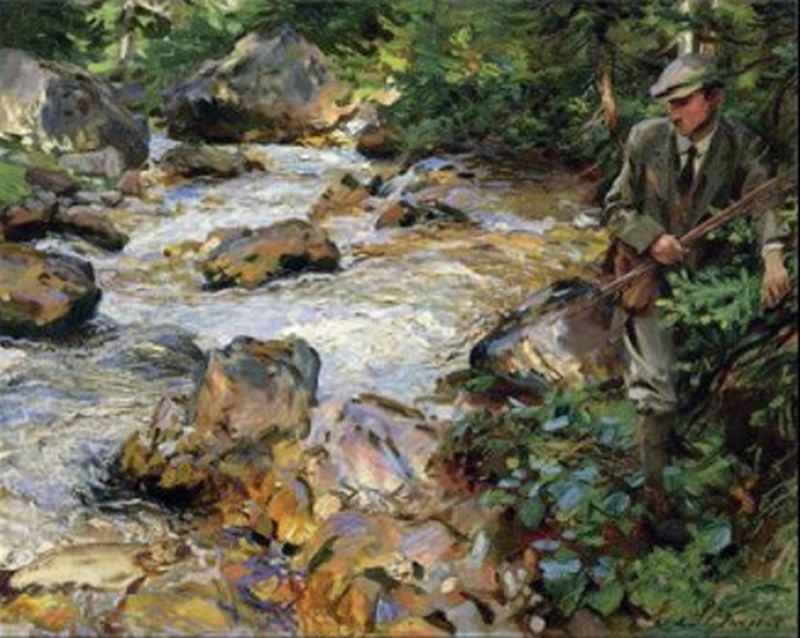
Trout Stream in the Tyrol (1914) by John Singer Sargent
John Singer Sargent’s Trout Stream in the Tyrol, painted in 1914, is an oil-on-canvas work measuring 55.88 by 71.12 cm. Associated with the loose, light-filled handling of Impressionism, the painting brings the viewer into a lively mountain landscape where water, stone, and foliage are caught in motion.
Sargent sets the stream rushing through the rugged Tyrolean terrain, using quick, fluid brushwork to suggest the sparkle and force of moving water. The surrounding greens and rocky textures give the scene a vivid outdoor freshness. At the edge of the stream, a fisherman stands with his rod, quietly absorbed in the landscape. His presence adds a human stillness to the restless energy of the water, turning the painting into both a study of nature and a moment of contemplative solitude.
Trout Stream in the Tyrol (1914) by John Singer Sargent
The alders went bare above us,
came blue lightning jagged and ragged
as scars on his arms, the proud chest,
not welts in the beginning but Swastika-
made, bayonet-gathered somewhere
south of France, high-dry Saharan.
Leaves, forsaken, were false blasts about limbs;
from small explosions came huge expulsions.
He recalled the remarkable incumbent grace
and energy of grenades, the godness of them, ethereal,
whooshing off to nowhere unless you happened
to get in their way, conclusively, incisively.
He said, “The taste of shrapnel hangs on like
a pewter key you mouthed as a sassy child,
to get in their way, conclusively, incisively.
a wired can your father drank from which you’d
sneak a few drafts from for yourself in the cellar,
nails you mouth-cached, silvered, lead-painted,
wetted, iron-on-the-tongue gray-heavy metal
you’ve only dreamed of since. Yet, where he’s come
to since that eventful sand wasn’t all he knew.
On our backs, the bare alder limbs mere
antennae in the late afternoon above us, October’s
flies grounded for illustrious moments, the squawk
at our trespass merely a handful of crows
in their magnificent kingdom, he brought home
the last of his brothers, goggle-eyed veteran tankers,
tinker Tommies under the Union Jack,
raw Senegalese old sentries still worry about,
dry bodies fifty years under mummifying sand,
perhaps put away forever, and then some.
He thinks Egypt has a whole new strain of sleepers
fifty years down the road of their making, the wrap
of sand as good as Tutankhamen had at hand,
their khaki blouses coming up a detective’s work,
a special digger’s knowledge, at last citing army,
corps, division, regiment, battalion, company,
father, brother, son, neighbor, face, eye, lip, hand,
soul, out there on the everlasting shift of sand,
the stars still falling, angular, apogean,
tailing across somewhere a dark night. Here, our worms, second
place to uniqueness of fashioned flies, keen hackles,
are ready for small orbits, small curves,
huge mouths. And his battles, faded into the high limbs,
a flag run up after all this recapture, say he knows yet
and ever Egypt's two dark eyes.
|