The Art of Federico García Lorca
A gallery of drawings by Federico García Lorca, revealing the visual imagination of the celebrated Spanish poet and dramatist. Created largely between 1927 and 1931, these expressive works draw upon recurring Lorcan images of music, desire, solitude, death, the moon and the divided self.
Soledad Montoya, 1930
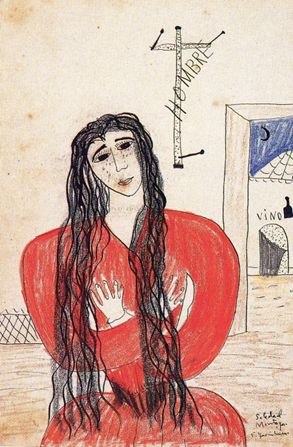
A seated woman in a vivid red dress holds her hands against her chest while her extraordinarily long black hair falls across her shoulders and lap. Behind her, Lorca sketches a sparse street scene with a telegraph pole and a small shop displaying a bottle of wine. The restrained background and intense red garment draw attention to Soledad’s solemn, inward-looking figure. |
Poems Del Anzuelo 1927
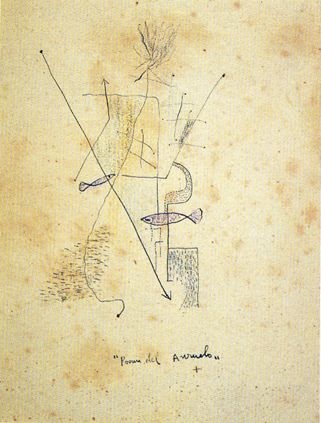
A delicate, dreamlike drawing composed of fine intersecting lines, arrows and lightly sketched forms. Two small fish appear among abstract shapes suggesting hooks, nets, water and fragments of landscape. The sparse marks and generous empty space give the work the quality of a poetic diagram suspended on the page.
Paseo De Una Avispa Por Mi Cualto
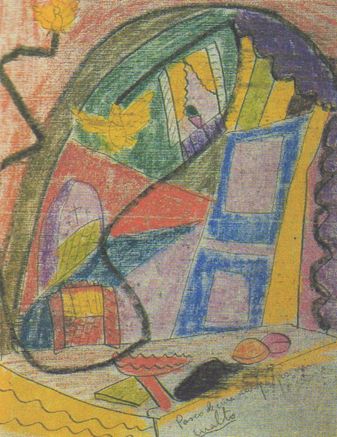
A colourful, enclosed interior is broken into overlapping geometric planes of green, blue, yellow, red and violet. Doors, windows and pieces of furniture appear tilted and compressed beneath a dark arch, while the small yellow form of a wasp moves through the upper part of the room. The shifting angles transform its flight into a lively, dreamlike journey through space.
Guitarra, 1927
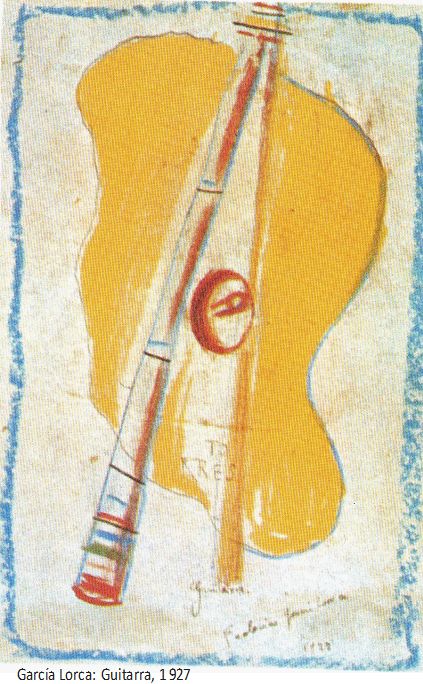
A stylised guitar is reduced to a few strong lines and broad areas of colour. Its slender neck crosses the warm golden curves of the body, while a red-ringed sound hole resembles a watchful eye. Framed by an uneven blue border, the instrument appears both familiar and strangely alive.
La Vista y El Tacto, 1929, 1930
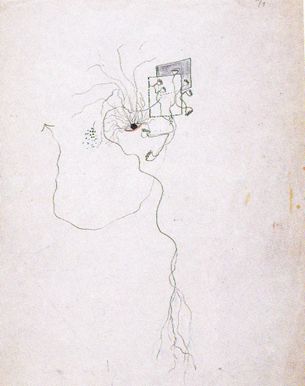
A lightly drawn human profile emerges from an expanse of almost empty paper. Around the eye and forehead, delicate branching lines spread like nerves, roots or searching fingers, meeting a small geometric form that partly encloses the face. A single wavering line descends from the head and divides into root-like strands, linking sight and touch through the body’s fragile sensory network.
Deseo de las ciudades Muertas (1929 - 1930)
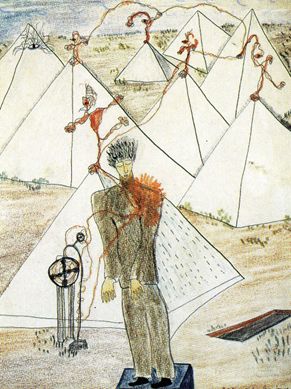
A solitary dark figure stands amid a strange landscape of white pyramidal buildings. Red, flame-like forms twist across their peaks, while a burst of red rises from the figure’s chest. Beside him stands a small mechanical or skeletal form, and a dark opening cuts into the ground. The sharp geometry and scattered signs of fire create a desolate, unsettling vision of a city emptied of ordinary life.
Autorretrato en Nueva York 1920 - 1930
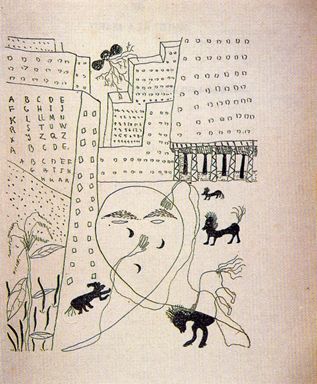
Lorca’s large, mask-like face floats within a crowded New York cityscape of tall buildings, repeated windows and scattered letters. Dark animal forms prowl around the portrait, while delicate plants and disembodied, branch-like hands rise at either side. The poet’s closed or downcast eyes give the self-portrait a withdrawn, vulnerable quality amid the noise and strangeness of the city.
Sirena 1927
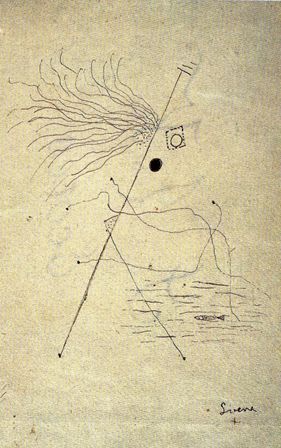
A mermaid-like figure is drawn with a few fine, angular lines against an almost empty background. Long strands of hair stream dramatically from her head, while one circular eye and a solid black mark define the spare, mask-like face. Her body dissolves into rippling horizontal strokes, suggesting water, movement and an elusive form seen beneath the surface.
El Beso, Gardia-Lorca
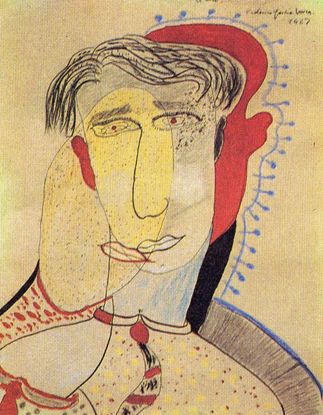
Two faces overlap so closely that their profiles, lips and features appear to merge in a kiss. Fine black lines define the hair and elongated central face, while areas of red, yellow, blue and grey divide and bind the figures together. The doubled mouths and interwoven outlines convey intimacy, but also a dreamlike uncertainty about where one person ends and the other begins.
Teorema Del Jarro, 1927
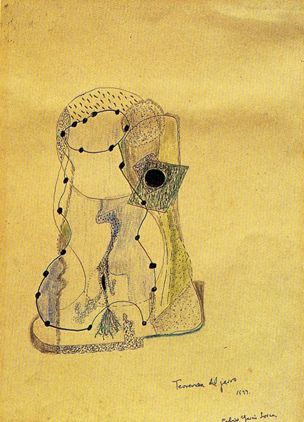
A jug-like vessel is transformed into a curious organic figure assembled from looping outlines, shaded compartments and a chain of black dots. A large dark circle suggests an eye or opening, while smaller interior forms resemble limbs, roots and fragments of anatomy. The work hovers between still life and living creature, turning an ordinary household object into a mysterious visual proposition.
Puta y Luna (1929 - 1931 )
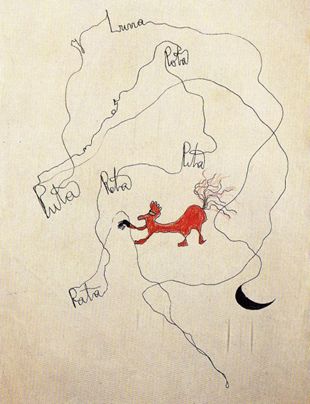
Thin, wandering lines form an irregular enclosure across the otherwise empty page, repeatedly interrupted by the handwritten words puta and luna. At the centre stands a vivid red horse-like creature accompanied by a small dark figure, while a black crescent moon hangs near the lower edge. The scattered words, drifting boundaries and isolated symbols give the drawing the quality of a private map or unsettling dream.
Busto de Hombre Muerto
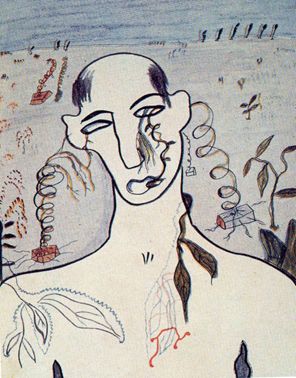
A pale, broad-shouldered male bust fills the page, its face drawn with heavy, asymmetrical features and half-closed eyes. Dark, tear-like lines descend from one eye, while coiled forms frame the head and scattered leaves, flowers and small symbols surround the body. Against the blue-grey background, the exposed figure appears suspended between portrait, memorial and dream.
Muerto de Amor, 1930
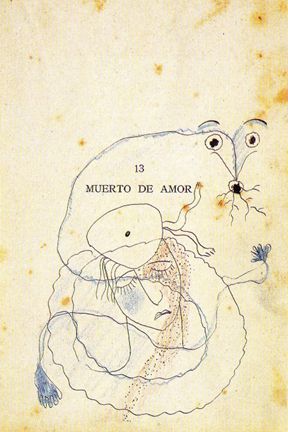
A fragile human figure appears folded inward beneath a large, enclosing form, its face partially hidden among overlapping lines and layers. Two watchful, bird-like eyes rise above it, joined at a point from which dark root-like threads descend. Blue hands extend from either side, while the printed words Muerto de amor become part of the composition. The image brings tenderness, confinement and sorrow together in a strange vision of love and death.
Payaso de rostro desdoblado y cáliz, 1927
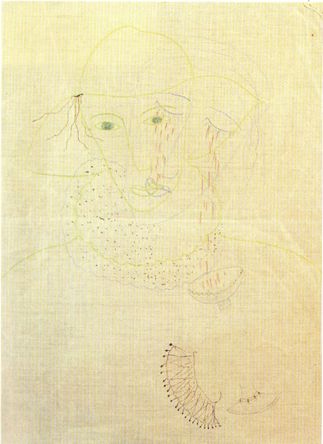
An extremely delicate clown’s face emerges from faint, overlapping lines, its features doubled as though two expressions or identities occupy the same head. Fine trails of dots and thread-like marks descend through the pale figure towards a small chalice and curved, fan-like forms below. The near-vanishing lines give the drawing a fragile, spectral quality, poised between appearance and disappearance.
Federico García Lorca
In this almost weightless drawing, Lorca allows the clown’s face to divide and overlap, as though a public expression were slipping away to reveal another self beneath it. The faint lines, scattered dots and chalice-like form give the figure the air of an apparition: comic and ceremonial, but also fragile, divided and close to vanishing.
Federico García Lorca