Artist Rooms
Gallery Viewer
Click on an image to expand it on screen.
Choose a gallery from the menu. The selected gallery will open here inside Artist Rooms.
2016 Images for the 'Rubén Darío' essay
This gallery accompanies Stephen Zelnick's essay on Rubén Darío, placing the Nicaraguan poet within the literary, political and cultural world that shaped his work. Portraits of Darío sit alongside images of Nicaragua, Momotombo, Paris and New York, while references to Pythagoras, Nezahualcoyotl, Camille, Roosevelt and the Sandinista movement extend the essay’s discussion of Modernismo, history, identity and power. Together, the images form a visual commentary on Darío’s life and imagination: his fascination with Europe, his attachment to Latin America, and his response to the cultural and political forces surrounding him.
Close ×
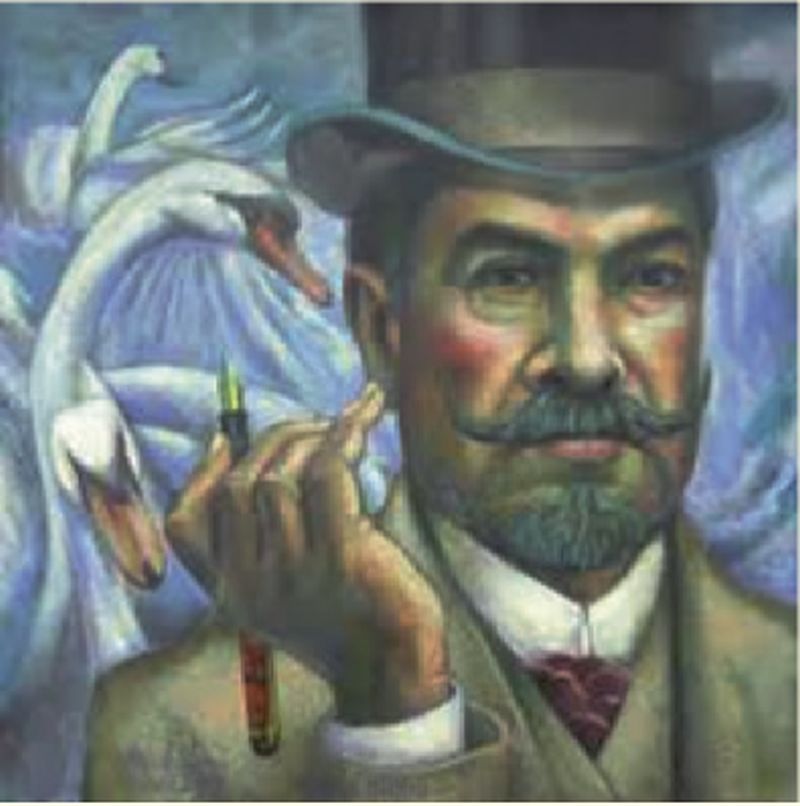
Sergio Michilini portrays the Nicaraguan poet Rubén Darío in formal dress and top hat, his composed face dominating the foreground while he holds a pen between raised fingers. Behind him, white swans emerge through a cool blue, dreamlike setting. The combination of portraiture, writing and symbolic imagery gives Darío the presence of both historical figure and poetic invention, while the swans evoke the imaginative world closely associated with Modernismo. |
Retrato de Rubén Darío Sergio Michilini portrays the Nicaraguan poet Rubén Darío in formal dress and top hat, his composed face dominating the foreground while he holds a pen between raised fingers. Behind him, white swans emerge through a cool blue, dreamlike setting. The combination of portraiture, writing and symbolic imagery gives Darío the presence of both historical figure and poetic invention, while the swans evoke the imaginative world closely associated with Modernismo. Sergio Michilini |

Close ×
Nicaragua, the largest nation in the Central American isthmus, gained independence from Spain in 1821; the US occupied the country from 1909–1933; the Somoza family, US proxies, ruled from 1927–1979; in the 1980s the Sandinistas prevailed, withstanding a terror campaign directed by the Reagan administration. Nicaragua is now a liberal democracy. |
Nicaragua Nicaragua, the largest nation in the Central American isthmus, gained independence from Spain in 1821; the US occupied the country from 1909–1933; the Somoza family, US proxies, ruled from 1927–1979; in the 1980s the Sandinistas prevailed, withstanding a terror campaign directed by the Reagan administration. Nicaragua is now a liberal democracy. Map source not identified in the archived material |

Close ×
Like many Nicaraguans, Darío was mestizo with dark complexion. This meant he struggled to gain diplomatic postings to Europe, the most common route for artists. While Europe intrigued him, he embraced his indigenous origins when the US threatened Hispanic culture. |
Rubén Darío — Early Portrait Like many Nicaraguans, Darío was mestizo with dark complexion. This meant he struggled to gain diplomatic postings to Europe, the most common route for artists. While Europe intrigued him, he embraced his indigenous origins when the US threatened Hispanic culture. Photographer/source not identified in the archived caption |

Close ×
No works of Pythagoras of Samos (570-495 BCE) survive, but legend identifies him as the author of the famous geometric theorems we all know. He is also said to have been a philosopher who influenced Plato profoundly in his notions of the rational basis for all existence. |
Pythagoras of Samos No works of Pythagoras of Samos (570-495 BCE) survive, but legend identifies him as the author of the famous geometric theorems we all know. He is also said to have been a philosopher who influenced Plato profoundly in his notions of the rational basis for all existence. Artist/source not identified in the archived captio |

Close ×
This attractive photo shows a young and handsome Darío in Paris. |
Rubén Darío in Paris This attractive photo shows a young and handsome Darío in Paris. Photographer/source not identified in the archived caption |

Close ×
Greta Garbo and Robert Taylor in the 1936 film Camille, based on Alexandre Dumas fils’s novel La Dame aux Camélias (1848). Garbo played Margarita Gautier, the doomed courtesan pursued by her idealistic young lover. Darío’s treatment is sardonic, rejecting the false illusions of her young lover. |
Camille Greta Garbo and Robert Taylor in the 1936 film Camille, based on Alexandre Dumas fils’s novel La Dame aux Camélias (1848). Garbo played Margarita Gautier, the doomed courtesan pursued by her idealistic young lover. Darío’s treatment is sardonic, rejecting the false illusions of her young lover. Film still from Camille (1936), featuring Greta Garbo and Robert Taylor |

Close ×
“A ROOSEVELT” confronts the “great hunter, primitive and modern” about to overwhelm “innocent America”. With his “cult of skill” and lust for “setting things ablaze”, he may destroy Latin America. |
A Roosevelt “A ROOSEVELT” confronts the “great hunter, primitive and modern” about to overwhelm “innocent America”. With his “cult of skill” and lust for “setting things ablaze”, he may destroy Latin America. Artist/source not identified in the archived caption |

Close ×
Nezahualcoyotl (1402-1472) is remembered as a poet and philosopher and wise ruler of the city-state of Texcoco in pre-Columbian Mexico. His graceful statue looks out over Mexico City. |
Nezahualcoyotl Nezahualcoyotl (1402-1472) is remembered as a poet and philosopher and wise ruler of the city-state of Texcoco in pre-Columbian Mexico. His graceful statue looks out over Mexico City. Sculptor/photographer/source not identified in the archived caption |

Close ×
In 1979, the Sandinista Movement cast out the US-backed Somoza family that had ruled Nicaragua for 52 years. Its leader, and soon after President, Daniel Ortega, is one of the “thousands of cubs the Spanish Lion whelped.” |
Sandinista Rally, Nicaragua In 1979, the Sandinista Movement cast out the US-backed Somoza family that had ruled Nicaragua for 52 years. Its leader, and soon after President, Daniel Ortega, is one of the “thousands of cubs the Spanish Lion whelped.” Photographer/source not identified in the archived caption |

Close ×
Darío’s 1913 satiric portrait of New York City, La Gran Cosmopolis, anticipates Brecht’s opera Mahagonny (1930). New York City’s skyscrapers, fifty stories high, typify the massing of economic and cultural power and the global reach of the new colossus. |
New York City Skyscraper Darío’s 1913 satiric portrait of New York City, La Gran Cosmopolis, anticipates Brecht’s opera Mahagonny (1930). New York City’s skyscrapers, fifty stories high, typify the massing of economic and cultural power and the global reach of the new colossus. Artist/source not identified in the archived caption |

Close ×
This forceful image of Darío is the most regularly reproduced on book covers and at websites. |
Rubén Darío This forceful image of Darío is the most regularly reproduced on book covers and at websites. Photographer/source not identified in the archived caption |

Close ×
Momotombo is active volcano located on Lake Managua and serves as a proud symbol of Nicaragua. Darío’s poem (1907) seeks strength and wisdom from “the father of fire and stone”… “I beg /for the secret of your flames, your mystery of harmony, /the initiation you could give; /I thought of you in the immensity of Ossa and Pelion”. |
Momotombo Momotombo is active volcano located on Lake Managua and serves as a proud symbol of Nicaragua. Darío’s poem (1907) seeks strength and wisdom from “the father of fire and stone”… “I beg /for the secret of your flames, your mystery of harmony, /the initiation you could give; /I thought of you in the immensity of Ossa and Pelion”. Photographer/source not identified in the archived caption |